


View NSE4_FGT-7.0 Exam Question Dumps With Latest Demo [Sep 09, 2023]
Free NSE4_FGT-7.0 Test Questions Real Practice Test Questions
Fortinet NSE4_FGT-7.0 exam is aimed at network and security professionals who are responsible for the implementation and management of Fortinet security solutions. NSE4_FGT-7.0 exam covers a wide range of topics, including network security, firewall policies, VPNs, and web filtering. Professionals who pass the exam demonstrate their ability to configure and manage Fortinet's security solutions in a variety of environments.
Fortinet NSE4_FGT-7.0 exam is a certification exam offered by Fortinet, a global leader in cybersecurity solutions. NSE4_FGT-7.0 exam is designed to test the knowledge and skills of network security professionals in configuring, managing, and troubleshooting Fortinet’s FortiOS 7.0 security platform. NSE4_FGT-7.0 exam is intended for network security professionals who are responsible for implementing and managing security policies, and who have a good understanding of networking protocols and concepts.
Earning the Fortinet NSE4_FGT-7.0 certification is an excellent way for network and security professionals to enhance their career prospects. Fortinet NSE 4 - FortiOS 7.0 certification demonstrates that a candidate has the knowledge and skills required to use Fortinet products and solutions effectively. It is recognized globally and is highly valued by employers. Earning this certification can open up new career opportunities and lead to higher salaries. Overall, the Fortinet NSE4_FGT-7.0 exam is an excellent opportunity for professionals who want to demonstrate their knowledge and skills in using Fortinet products and solutions.
NEW QUESTION # 50
An administrator wants to configure Dead Peer Detection (DPD) on IPSEC VPN for detecting dead tunnels. The requirement is that FortiGate sends DPD probes only when no traffic is observed in the tunnel.
Which DPD mode on FortiGate will meet the above requirement?
- A. Enabled
- B. On Demand
- C. On Idle
- D. Disabled
Answer: C
NEW QUESTION # 51
Refer to the exhibit.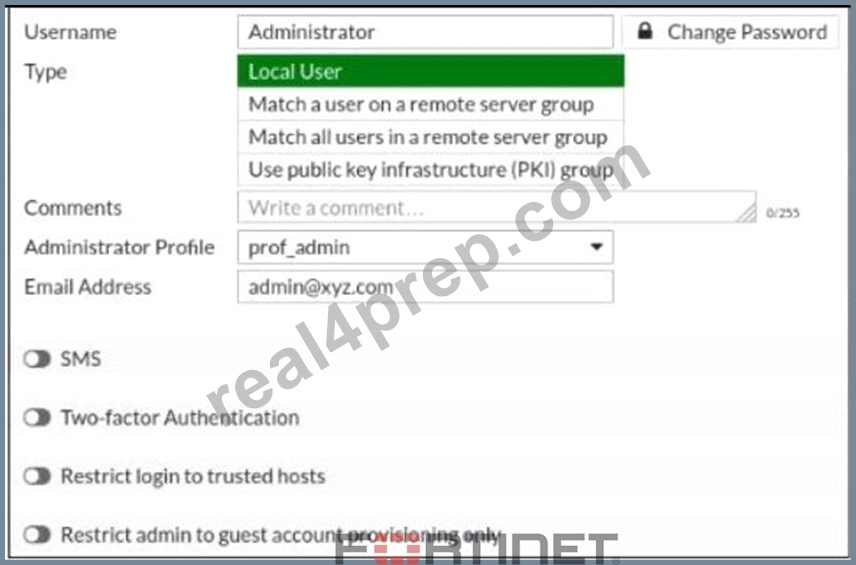
The global settings on a FortiGate device must be changed to align with company security policies. What does the Administrator account need to access the FortiGate global settings?
- A. Enable two-factor authentication
- B. Enable restrict access to trusted hosts
- C. Change Administrator profile
- D. Change password
Answer: C
NEW QUESTION # 52
Refer to the exhibit, which contains a radius server configuration.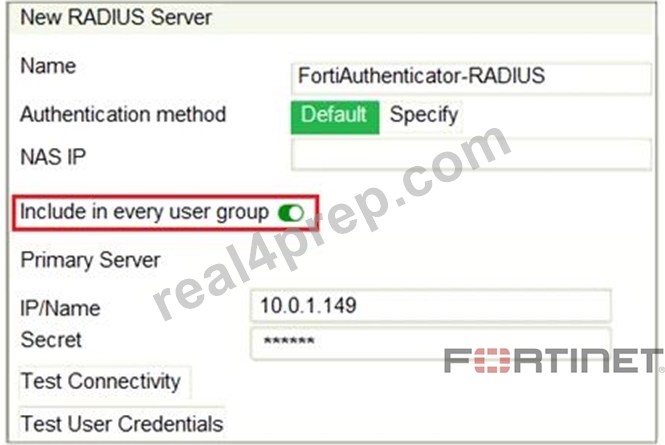
An administrator added a configuration for a new RADIUS server. While configuring, the administrator selected the Include in every user group option.
What will be the impact of using Include in every user group option in a RADIUS configuration?
- A. This option places all FortiGate users and groups required to authenticate into the RADIUS server, which, in this case, is FortiAuthenticator.
- B. This option places all users into every RADIUS user group, including groups that are used for the LDAP server on FortiGate.
- C. This option places the RADIUS server, and all users who can authenticate against that server, into every RADIUS group.
- D. This option places the RADIUS server, and all users who can authenticate against that server, into every FortiGate user group.
Answer: D
NEW QUESTION # 53
You have enabled logging on your FortiGate device for Event logs and all Security logs, and you have set up logging to use the FortiGate local disk.
What is the default behavior when the local disk is full?
- A. Logs are overwritten and the only warning is issued when log disk usage reaches the threshold of 95%.
- B. Logs are overwritten and the first warning is issued when log disk usage reaches the threshold of 75%.
- C. No new log is recorded until you manually clear logs from the local disk.
- D. No new log is recorded after the warning is issued when log disk usage reaches the threshold of 95%.
Answer: B
NEW QUESTION # 54
Which two protocols are used to enable administrator access of a FortiGate device? (Choose two.)
- A. FTM
- B. FortiTelemetry
- C. HTTPS
- D. SSH
Answer: C,D
Explanation:
Reference:
https://docs.fortinet.com/document/fortigate/6.4.0/hardening-your-fortigate/995103/buildingsecurity-into-fortios
NEW QUESTION # 55
Refer to the exhibit.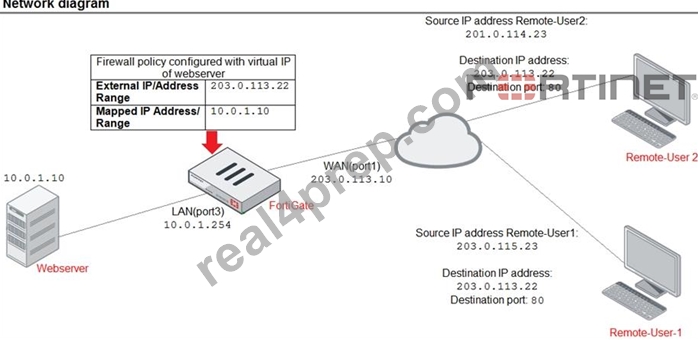

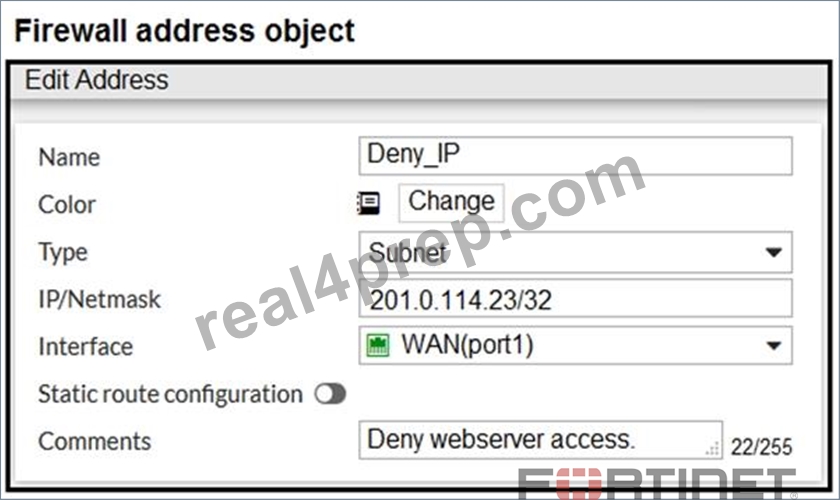
The exhibit contains a network diagram, firewall policies, and a firewall address object configuration.
An administrator created a Deny policy with default settings to deny Webserver access for Remote-user2. Remote-user2 is still able to access Webserver.
Which two changes can the administrator make to deny Webserver access for Remote-User2? (Choose two.)
- A. Enable match vip in the Deny policy.
- B. Set the Destination address as Web_server in the Deny policy.
- C. Set the Destination address as Deny_IP in the Allow-access policy.
- D. Disable match-vip in the Deny policy.
Answer: A,B
Explanation:
https://community.fortinet.com/t5/FortiGate/Technical-Tip-Firewall-does-not-block-incoming-WAN-to-LAN/ta-p/189641
NEW QUESTION # 56
Examine the IPS sensor and DoS policy configuration shown in the exhibit, then answer the question below.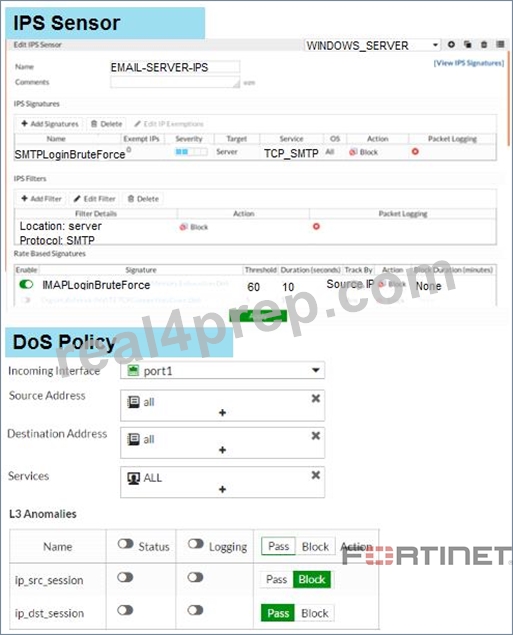
When detecting attacks, which anomaly, signature, or filter will FortiGate evaluate first?
- A. IMAP.Login.brute.Force
- B. ip_src_session
- C. SMTP.Login.Brute.Force
- D. Location: server Protocol: SMTP
Answer: A
NEW QUESTION # 57
Refer to the exhibit.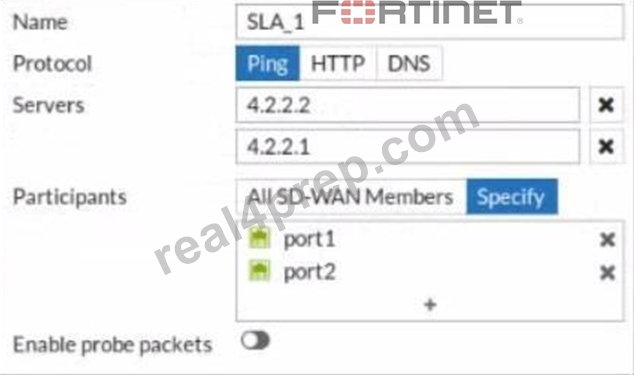
An administrator has configured a performance SLA on FortiGate, which failed to generate any traffic.
Why is FortiGate not sending probes to 4.2.2.2 and 4.2.2.1 servers? (Choose two.)
- A. The Detection Mode setting is not set to Passive.
- B. The Enable probe packets
- C. The configured participants are not SD-WAN members.
- D. Administrator didn't configure a gateway for the SD-WAN members, or configured gateway is not valid.
Answer: B,D
NEW QUESTION # 58
Refer to the exhibit to view the firewall policy.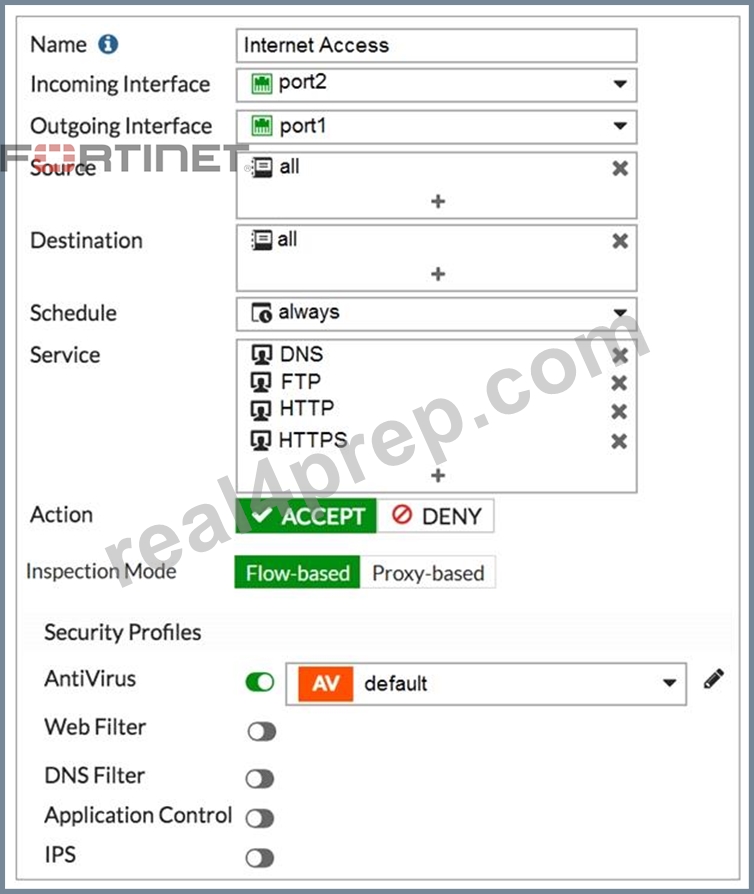
Which statement is correct if well-known viruses are not being blocked?
- A. The action on the firewall policy must be set to deny.
- B. The firewall policy does not apply deep content inspection.
- C. Web filter should be enabled on the firewall policy to complement the antivirus profile.
- D. The firewall policy must be configured in proxy-based inspection mode.
Answer: B
NEW QUESTION # 59
Refer to the exhibit.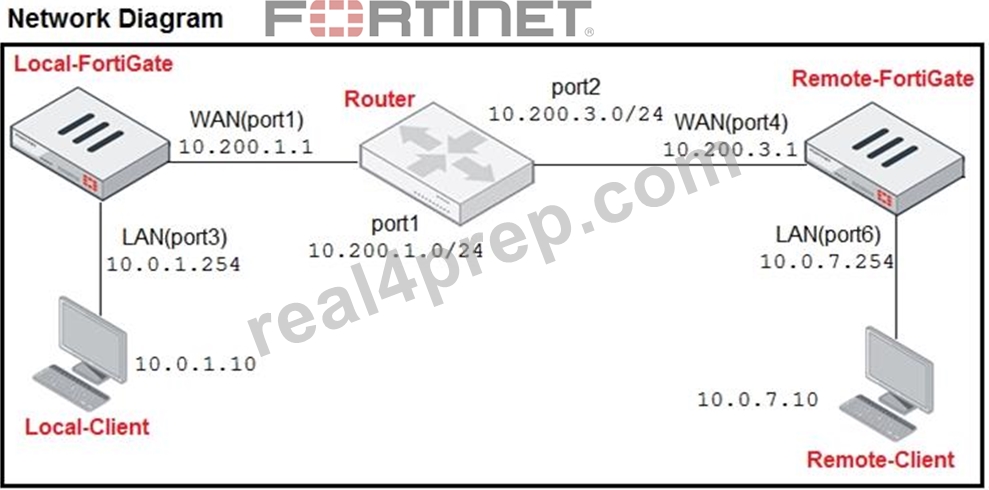
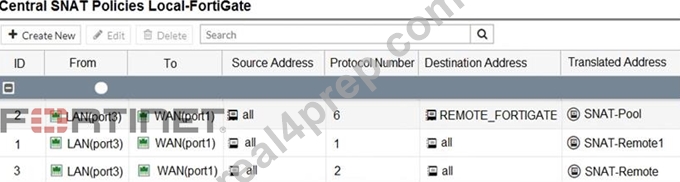
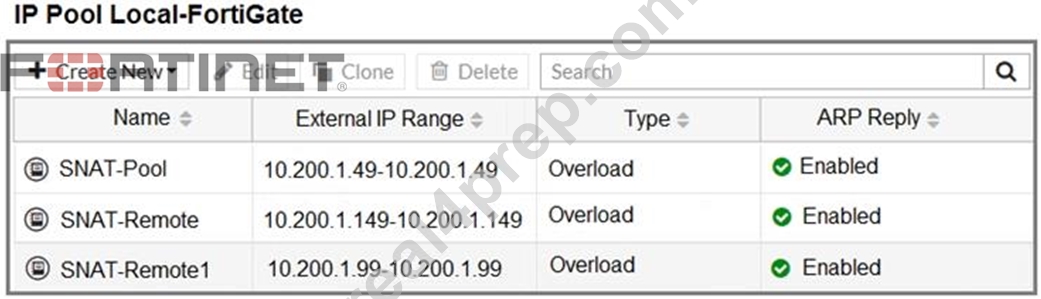
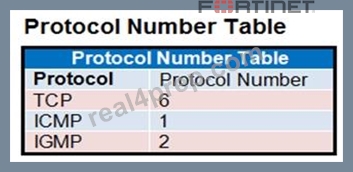
The exhibit contains a network diagram, central SNAT policy, and IP pool configuration.
The WAN (port1) interface has the IP address 10.200.1.1/24.
The LAN (port3) interface has the IP address 10.0.1.254/24.
A firewall policy is configured to allow to destinations from LAN (port3) to WAN (port1).
Central NAT is enabled, so NAT settings from matching Central SNAT policies will be applied.
Which IP address will be used to source NAT the traffic, if the user on Local-Client (10.0.1.10) pings the IP address of Remote-FortiGate (10.200.3.1)?
- A. 10.200.1.99
- B. 10.200.1.1
- C. 10.200.1.49
- D. 10.200.1.149
Answer: A
Explanation:
Explanation
Ping is ICMP protocol - protocol number = 1 => SNAT policy ID 1 is policy that used. => Translated address is "SNAT-Remote1" that 10.200.1.99
NEW QUESTION # 60
Refer to the exhibit.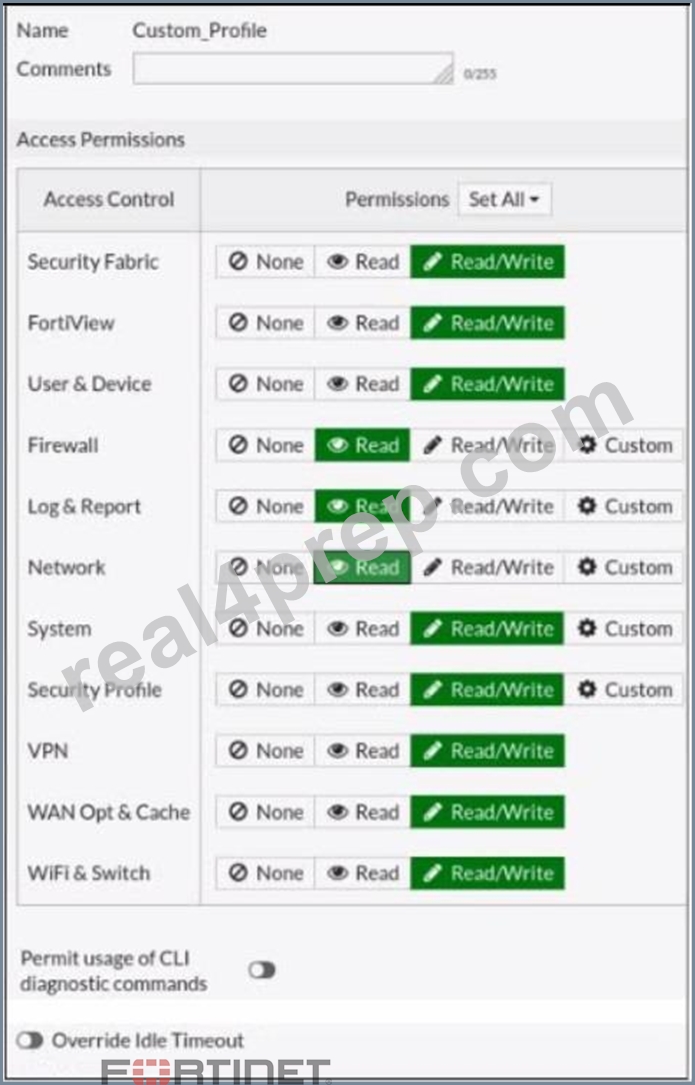
Based on the administrator profile settings, what permissions must the administrator set to run the diagnose firewall auth list CLI command on FortiGate?
- A. Custom permission for Network
- B. Read/Write permission for Log & Report
- C. CLI diagnostics commands permission
- D. Read/Write permission for Firewall
Answer: C
Explanation:
https://kb.fortinet.com/kb/documentLink.do?externalID=FD50220
NEW QUESTION # 61
View the exhibit: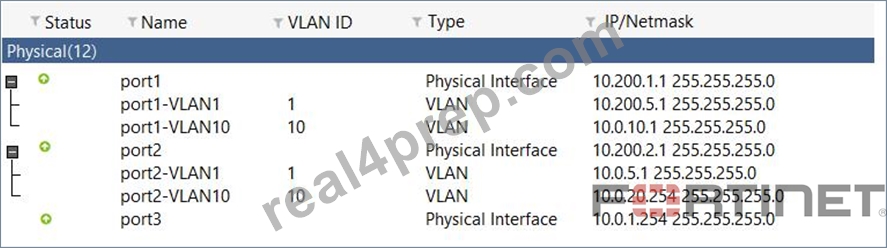
Which the FortiGate handle web proxy traffic rue? (Choose two.)
- A. port-VLAN1 is the native VLAN for the port1 physical interface.
- B. port1-VLAN10 and port2-VLAN10 can be assigned to different VDOMs.
- C. Broadcast traffic received in port1-VLAN10 will not be forwarded to port2-VLAN10.
- D. Traffic between port1-VLAN1 and port2-VLAN1 is allowed by default.
Answer: B,C
NEW QUESTION # 62
Which statement is correct regarding the inspection of some of the services available by web applications embedded in third-party websites?
- A. FortiGuard maintains only one signature of each web application that is unique.
- B. The security actions applied on the web applications will also be explicitly applied on the third-party websites.
- C. FortiGate can inspect sub-application traffic regardless where it was originated.
- D. The application signature database inspects traffic only from the original web application server.
Answer: C
NEW QUESTION # 63
Which certificate value can FortiGate use to determine the relationship between the issuer and the certificate?
- A. Subject value
- B. SMMIE Capabilities value
- C. Subject Key Identifier value
- D. Subject Alternative Name value
Answer: C
NEW QUESTION # 64
A network administrator is configuring a new IPsec VPN tunnel on FortiGate. The remote peer IP address is dynamic. In addition, the remote peer does not support a dynamic DNS update service.
What type of remote gateway should the administrator configure on FortiGate for the new IPsec VPN tunnel to work?
- A. Dynamic DNS
- B. Static IP Address
- C. Dialup User
- D. Pre-shared Key
Answer: C
Explanation:
Explanation
Dialup user is used when the remote peer's IP address is unknown. The remote peer whose IP address is unknown acts as the dialup clien and this is often the case for branch offices and mobile VPN clients that use dynamic IP address and no dynamic DNS
NEW QUESTION # 65
Refer to the exhibit, which contains a radius server configuration.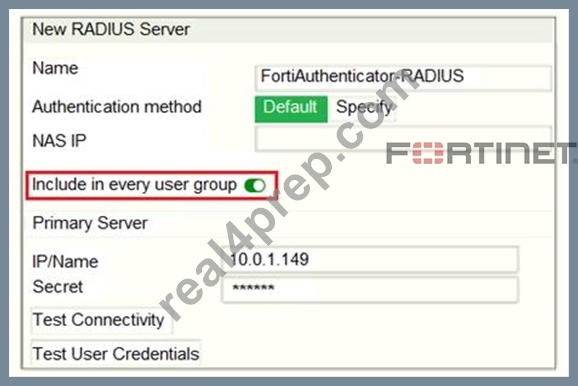
An administrator added a configuration for a new RADIUS server. While configuring, the administrator selected the Include in every user group option.
What will be the impact of using Include in every user group option in a RADIUS configuration?
- A. This option places all FortiGate users and groups required to authenticate into the RADIUS server, which, in this case, is FortiAuthenticator.
- B. This option places all users into every RADIUS user group, including groups that are used for the LDAP server on FortiGate.
- C. This option places the RADIUS server, and all users who can authenticate against that server, into every RADIUS group.
- D. This option places the RADIUS server, and all users who can authenticate against that server, into every FortiGate user group.
Answer: D
Explanation:
Reference: https://docs.fortinet.com/document/fortigate/6.0.0/handbook/634373/authentication-servers
NEW QUESTION # 66
In which two ways can RPF checking be disabled? (Choose two )
- A. Disable the RPF check at the FortiGate interface level for the source check
- B. Disable strict-arc-check under system settings.
- C. Enable asymmetric routing.
- D. Enable anti-replay in firewall policy.
Answer: B,C
Explanation:
Reference: https://kb.fortinet.com/kb/documentLink.do?externalID=FD33955
NEW QUESTION # 67
Refer to the exhibit.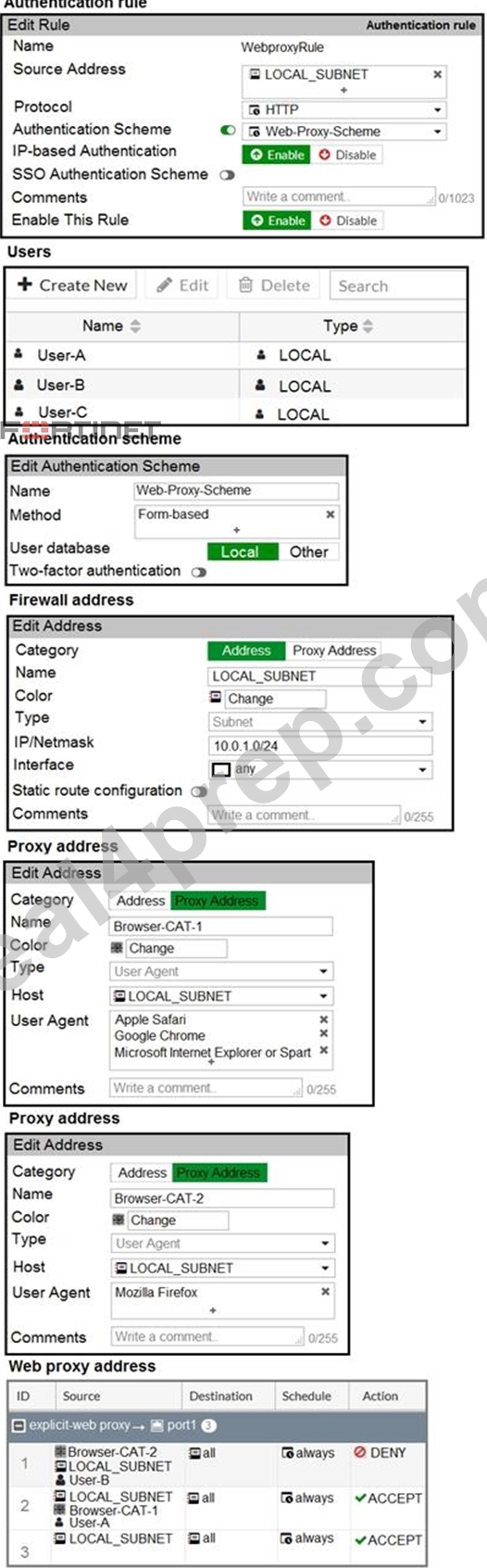
The exhibit shows proxy policies and proxy addresses, the authentication rule and authentication scheme, users, and firewall address.
An explicit web proxy is configured for subnet range 10.0.1.0/24 with three explicit web proxy policies.
The authentication rule is configured to authenticate HTTP requests for subnet range 10.0.1.0/24 with a form-based authentication scheme for the FortiGate local user database. Users will be prompted for authentication.
How will FortiGate process the traffic when the HTTP request comes from a machine with the source IP 10.0.1.10 to the destination http://www.fortinet.com? (Choose two.)
- A. If a Google Chrome browser is used with User-B credentials, the HTTP request will be allowed.
- B. If a Microsoft Internet Explorer browser is used with User-B credentials, the HTTP request will be allowed.
- C. If a Mozilla Firefox browser is used with User-B credentials, the HTTP request will be allowed.
- D. If a Mozilla Firefox browser is used with User-A credentials, the HTTP request will be allowed.
Answer: A,B
NEW QUESTION # 68
......
View All NSE4_FGT-7.0 Actual Free Exam Questions Updated: https://lead2pass.real4prep.com/NSE4_FGT-7.0-exam.html