


[Nov 22, 2024] Passing Key To Getting CCST-Networking Certified Exam Engine PDF
CCST-Networking Exam Dumps Pass with Updated Nov-2024 Tests Dumps
Cisco CCST-Networking Exam Syllabus Topics:
| Topic | Details |
|---|---|
| Topic 1 |
|
| Topic 2 |
|
| Topic 3 |
|
| Topic 4 |
|
| Topic 5 |
|
NEW QUESTION # 19
Which wireless security option uses a pre-shared key to authenticate clients?
- A. 802.1x
- B. WPA2-Enterprise
- C. WPA2-Personal
- D. 802.1q
Answer: C
Explanation:
WPA2-Personal, also known as WPA2-PSK (Pre-Shared Key), is the wireless security option that uses a pre-shared key to authenticate clients. This method is designed for home and small office networks and doesn't require an authentication server. Instead, every user on the network uses the same key or passphrase to connect1.
References :=
*What is a Wi-Fi Protected Access Pre-Shared Key (WPA-PSK)?
*Exploring WPA-PSK and WiFi Security
*WPA2-Personal: This wireless security option uses a pre-shared key (PSK) for authentication. Each client that connects to the network must use this key to gain access. It is designed for home and small office networks where simplicity and ease of use are important.
*WPA2-Enterprise: Unlike WPA2-Personal, WPA2-Enterprise uses 802.1x authentication with an authentication server (such as RADIUS) and does not rely on a pre-shared key.
*802.1x: This is a network access control protocol for LANs, particularly wireless LANs. It provides an authentication mechanism to devices wishing to attach to a LAN or WLAN.
*802.1q: This is a networking standard that supports VLAN tagging on Ethernet networks and is not related to wireless security.
References:
*Cisco Documentation on WPA2 Security: Cisco WPA2
*Understanding Wireless Security: Wireless Security Guide
NEW QUESTION # 20
A help desk technician receives the four trouble tickets listed below. Which ticket should receive the highest priority and be addressed first?
- A. Ticket 3: A user reports that response time for a cloud-based application is slower than usual.
- B. Ticket 1: A user requests relocation of a printer to a different network jack in the same office. The jack must be patched and made active.
- C. Ticket 4: Two users report that wireless access in the cafeteria has been down for the last hour.
- D. Ticket 2: An online webinar is taking place in the conference room. The video conferencing equipment lost internet access.
Answer: D
NEW QUESTION # 21
Move the security options from the list on the left to its characteristic on the right. You may use each security option once, more than once, or not at all.
Note: You will receive partial credit for each correct answer.
Answer:
Explanation: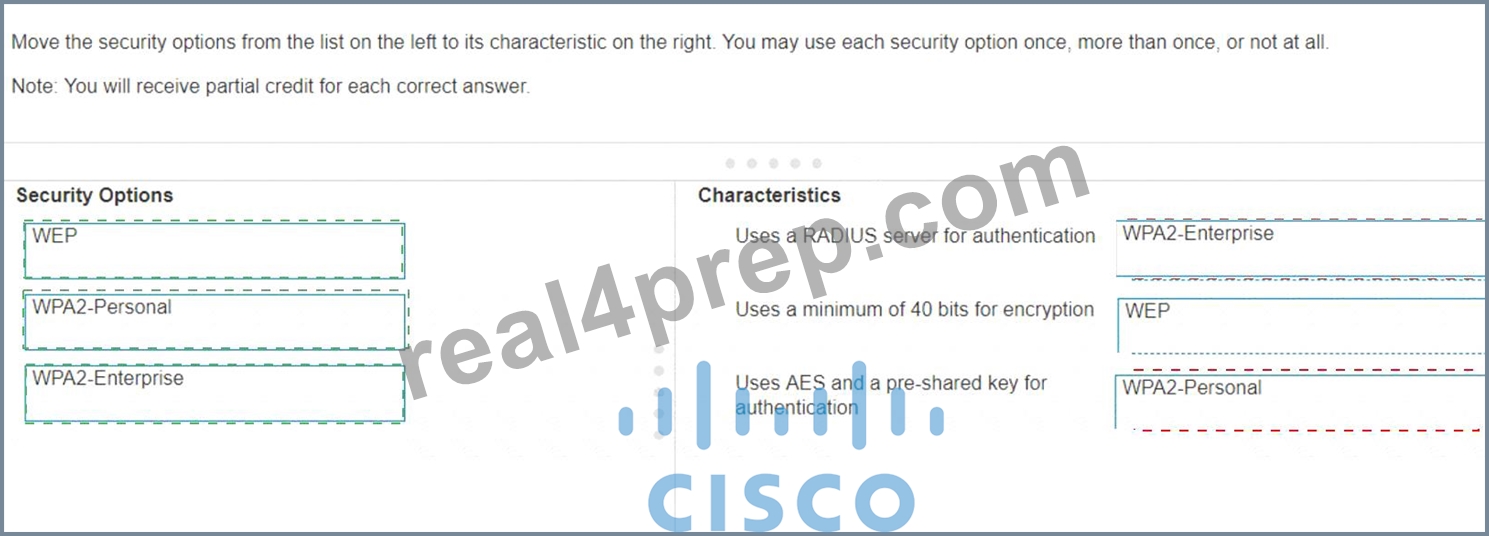
Explanation:
The correct matching of the security options to their characteristics is as follows:
* WPA2-Enterprise: Uses a RADIUS server for authentication
* WEP: Uses a minimum of 40 bits for encryption
* WPA2-Personal: Uses AES and a pre-shared key for authentication
Here's why each security option matches the characteristic:
* WPA2-Enterpriseuses a RADIUS server for authentication, which provides centralized Authentication, Authorization, and Accounting (AAA) management for users who connect and use a network service.
* WEP (Wired Equivalent Privacy)is an outdated security protocol that uses a minimum of 40 bits for encryption (and up to 104 bits), which is relatively weak by today's standards.
* WPA2-Personal(Wi-Fi Protected Access 2 - Personal) uses the Advanced Encryption Standard (AES) for encryption and a pre-shared key (PSK) for authentication, which is shared among users to access the network.
These security options are essential for protecting wireless networks from unauthorized access and ensuring data privacy.
NEW QUESTION # 22
A host is given the IP address 172.16.100.25 and the subnet mask 255.255.252.0.
What is the CIDR notation for this address?
- A. 172.16.100.25 /20
- B. 172.16.100.25 /23
- C. 172.16.100.25 /21
- D. 172.16.100.25 /22
Answer: D
Explanation:
The CIDR (Classless Inter-Domain Routing) notation for the subnet mask 255.255.252.0 is /22. This notation indicates that the first 22 bits of the IP address are used for network identification, and the remaining bits are used for host addresses within the network1.
References :=
*Subnet Cheat Sheet - 24 Subnet Mask, 30, 26, 27, 29, and other IP Address CIDR Network References
*Subnet Mask to CIDR Notation: The given subnet mask is 255.255.252.0. To convert this to CIDR notation:
*Convert the subnet mask to binary: 11111111.11111111.11111100.00000000
*Count the number of consecutive 1s in the binary form: There are 22 ones.
*Therefore, the CIDR notation is /22.
References:
*Understanding Subnetting and CIDR: Cisco CIDR Guide
NEW QUESTION # 23
A Cisco PoE switch is shown in the following image. Which type of port will provide both data connectivity and power to an IP phone?
- A. Ports identified with number 6
- B. Port identified with number 2
- C. Ports identified with number 7
- D. Ports identified with numbers 3 and 4
Answer: A
Explanation:
In the provided image of the Cisco PoE switch, the ports identified with number 6 are the standard RJ-45 Ethernet ports typically found on switches that provide both data connectivity and Power over Ethernet (PoE).
PoE ports are designed to supply power to devices such as IP phones, wireless access points, and other PoE-enabled devices directly through the Ethernet cable.
Ports:
*2: Console port (for management and configuration)
*3 and 4: Specific function ports (often for management)
*6: RJ-45 Ethernet ports (capable of providing PoE)
*7: SFP ports (for fiber connections, typically do not provide PoE)
Thus, the correct answer is C. Ports identified with number 6.
References :=
*Cisco Catalyst 2960-L Series Switches Data Sheet
*Cisco PoE Overview
NEW QUESTION # 24
During the data encapsulation process, which OSI layer adds a header that contains MAC addressing information and a trailer used for error checking?
- A. Session
- B. Data Link
- C. Transport
- D. Network
Answer: B
Explanation: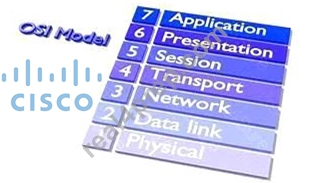
OSI model
During the data encapsulation process, theData Link layerof the OSI model is responsible for adding a header that contains MAC addressing information and a trailer used for error checking.The header typically includes the source and destination MAC addresses, while the trailer contains a Frame Check Sequence (FCS) which is used for error detection1.
The Data Link layer ensures that messages are delivered to the proper device on a LAN using hardware addresses and translates messages from the Network layer into bits for the Physical layer to transmit. It also controls how data is placed onto the medium and is received from the medium through the physical hardware.
References:=
* The OSI Model - The 7 Layers of Networking Explained in Plain English
* OSI Model - Network Direction
* Which layer adds both header and trailer to the data?
* What is OSI Model | 7 Layers Explained - GeeksforGeeks
NEW QUESTION # 25
You want to store files that will be accessible by every user on your network.
Which endpoint device do you need?
- A. Switch
- B. Access point
- C. Hub
- D. Server
Answer: D
Explanation:
To store files that will be accessible by every user on a network, you would need aserver. A server is a computer system that provides data to other computers. It can serve data to systems on a local network (LAN) or a wide network (WAN) over the internet.In this context, a file server would be set up to store and manage files, allowing users on the network to access them from their own devices1.
References:=
* What is a Server?
* Understanding Servers and Their Functions
A server is a computer designed to process requests and deliver data to other computers over a local network or the internet. In this case, to store files that will be accessible by every user on the network, a file server is the appropriate endpoint device. It provides a centralized location for storing and managing files, allowing users to access and share files easily.
* A. Access point: Provides wireless connectivity to a network.
* C. Hub: A basic networking device that connects multiple Ethernet devices together, making them act as a single network segment.
* D. Switch: A networking device that connects devices on a computer network by using packet switching to forward data to the destination device.
Thus, the correct answer is B. Server.
References:=
* File Server Overview (Cisco)
* Server Roles in Networking (Cisco)
NEW QUESTION # 26
You plan to use a network firewall to protect computers at a small office.
For each statement about firewalls, select True or False.
Note: You will receive partial credit for each correct selection.
Answer:
Explanation: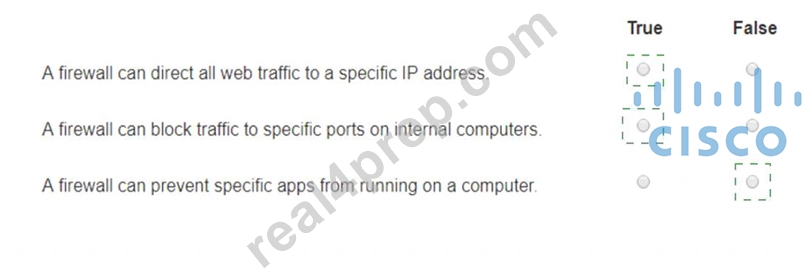
Explanation:
* A firewall can direct all web traffic to a specific IP address.
* True: Firewalls can be configured to perform Network Address Translation (NAT) and port forwarding, which can direct all web traffic (typically on port 80 and 443) to a specific internal IP address.
* A firewall can block traffic to specific ports on internal computers.
* True: Firewalls can be configured with access control lists (ACLs) or rules to block traffic to specific ports on internal computers, enhancing security by restricting unwanted or harmful traffic.
* A firewall can prevent specific apps from running on a computer.
* False: Firewalls typically control traffic flow and do not prevent specific applications from running on a computer. Application control is usually managed by endpoint security software or application control systems.
* Directing Web Traffic: Firewalls can manage traffic redirection using NAT and port forwarding rules to route web traffic to designated servers or devices within the network.
* Blocking Specific Ports: Firewalls can enforce security policies by blocking or allowing traffic based on port numbers, ensuring that only permitted traffic reaches internal systems.
* Application Control: While firewalls manage network traffic, preventing applications from running typically requires software specifically designed for endpoint protection and application management.
References:
* Understanding Firewalls: Firewall Capabilities
* Network Security Best Practices: Network Security Guide
NEW QUESTION # 27
A local company requires two networks in two new buildings. The addresses used in these networksmust be in the private network range.
Which two address ranges should the company use? (Choose 2.)
Note: You will receive partial credit for each correct selection.
- A. 192.16.0.0 to 192.16.255.255
- B. 172.16.0.0 to 172.31.255.255
- C. 11.0.0.0 to 11.255.255.255
- D. 192.168.0.0 to 192.168.255.255
Answer: B,D
Explanation:
The private IP address ranges that are set aside specifically for use within private networks and not routable on the internet are as follows:
* Class A: 10.0.0.0 to 10.255.255.255
* Class B: 172.16.0.0 to 172.31.255.255
* Class C: 192.168.0.0 to 192.168.255.255
These ranges are defined by the Internet Assigned Numbers Authority (IANA) and are used for local communications within a private network123.
Given the options: A.172.16.0.0 to 172.31.255.255falls within the Class B private range. B.192.16.0.0 to
192.16.255.255is not a recognized private IP range. C.11.0.0.0 to 11.255.255.255is not a recognized private IP range. D.192.168.0.0 to 192.168.255.255falls within the Class C private range.
Therefore, the correct selections that the company should use for their private networks areAandD.
References:=
* Reserved IP addresses on Wikipedia
* Private IP Addresses in Networking - GeeksforGeeks
* Understanding Private IP Ranges, Uses, Benefits, and Warnings
NEW QUESTION # 28
For each statement about bandwidth and throughput, select True or False.
Note: You will receive partial credit for each correct selection.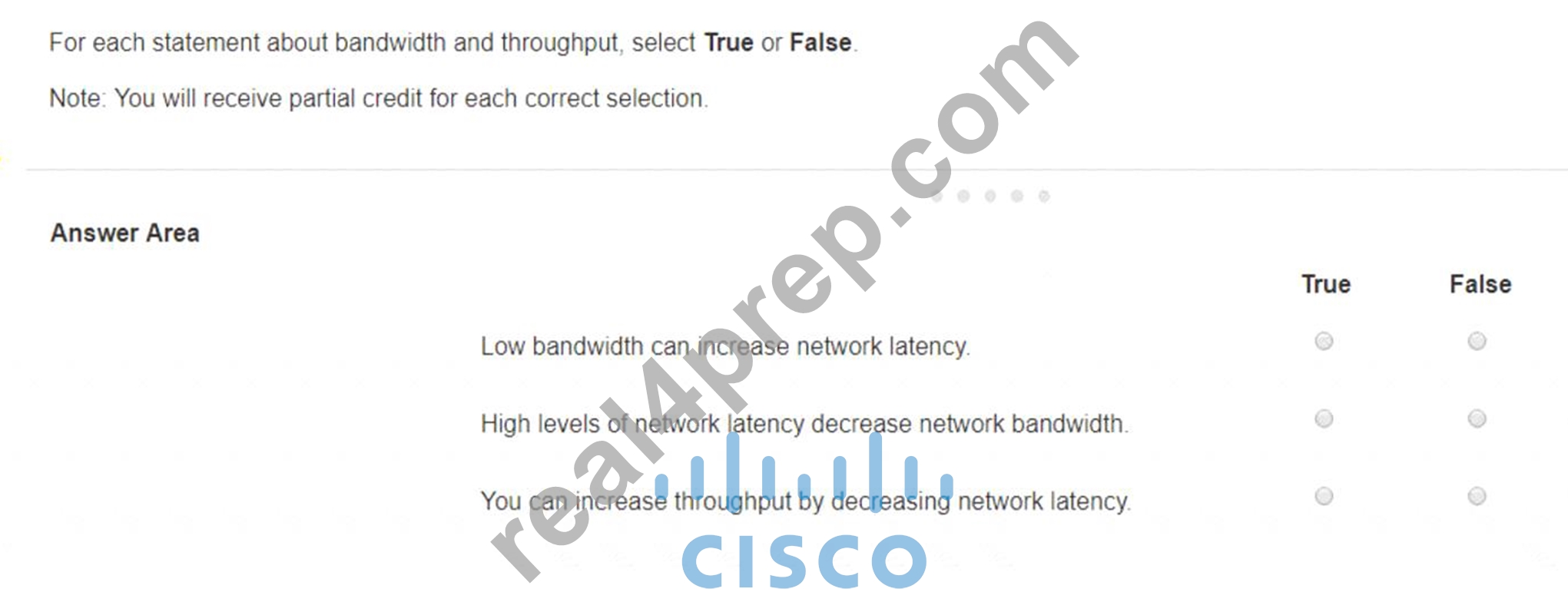
Answer:
Explanation:
Explanation:
* Statement 1: Low bandwidth can increase network latency.
* True: Low bandwidth can result in increased network latency because the network may become congested, leading to delays in data transmission.
* Statement 2: High levels of network latency decrease network bandwidth.
* False: High levels of network latency do not decrease the available network bandwidth, but they do affect the perceived performance and throughput of the network.
* Statement 3: You can increase throughput by decreasing network latency.
* True: Decreasing network latency can increase throughput because data can be transmitted more quickly and efficiently without delays.
* Bandwidth vs. Latency: Bandwidth refers to the maximum rate at which data can be transferred over a network path. Latency is the time it takes for a data packet to travel from the source to the destination.
* Low bandwidth can cause network congestion, which can increase latency as packets wait to be transmitted.
* High latency does not reduce the actual bandwidth but can affect the overall performance and efficiency of data transmission.
* Reducing latency can lead to higher throughput because the network can handle more data in a given period without delays.
References:
* Network Performance Metrics: Cisco Network Performance
* Understanding Bandwidth and Latency: Bandwidth vs. Latency
NEW QUESTION # 29
Which address is included in the 192.168.200.0/24 network?
- A. 192.168.200.13
- B. 192.168.199.13
- C. 192.168.1.13
- D. 192.168.201.13
Answer: A
Explanation:
*192.168.200.0/24 Network: This subnet includes all addresses from 192.168.200.0 to 192.168.200.255. The
/24 indicates a subnet mask of 255.255.255.0, which allows for 256 addresses.
*192.168.199.13: This address is in the 192.168.199.0/24 subnet, not the 192.168.200.0/24 subnet.
*192.168.200.13: This address is within the 192.168.200.0/24 subnet.
*192.168.201.13: This address is in the 192.168.201.0/24 subnet, not the 192.168.200.0/24 subnet.
*192.168.1.13: This address is in the 192.168.1.0/24 subnet, not the 192.168.200.0/24 subnet.
References:
*Subnetting Guide: Subnetting Basics
NEW QUESTION # 30
What is the purpose of assigning an IP address to the management VLAN interface on a Layer 2 switch?
- A. To enable the switch to resolve URLs for the attached the devices
- B. To enable the switch to act as a default gateway for the attached devices
- C. To enable the switch to provide DHCP services to other switches in the network
- D. To enable access to the CLI on the switch through Telnet or SSH
Answer: D
Explanation:
The primary purpose of assigning an IP address to the management VLAN interface on a Layer 2 switch is to facilitate remote management of the switch. By configuring an IP address on the management VLAN, network administrators can access the switch's Command Line Interface (CLI) remotely using protocols such as Telnet or Secure Shell (SSH). This allows for convenient configuration changes, monitoring, and troubleshooting without needing physical access to the switch1.
References :=
*Understanding the Management VLAN
*Cisco - VLAN Configuration Guide
*Remote Management of Switches
Assigning an IP address to the management VLAN interface (often the VLAN 1 interface by default) on a Layer 2 switch allows network administrators to remotely manage the switch using protocols such as Telnet or SSH. This IP address does not affect the switch's ability to route traffic between VLANs but provides a means to access and configure the switch through its Command Line Interface (CLI).
*A: The switch does not act as a default gateway; this is typically a function of a Layer 3 device like a router.
*B: The switch does not resolve URLs; this is typically a function of DNS servers.
*C: The switch can relay DHCP requests but does not typically provide DHCP services itself; this is usually done by a dedicated DHCP server or router.
Thus, the correct answer is D. To enable access to the CLI on the switch through Telnet or SSH.
References :=
*Cisco VLAN Management Overview
*Cisco Catalyst Switch Management
NEW QUESTION # 31
Examine the following output: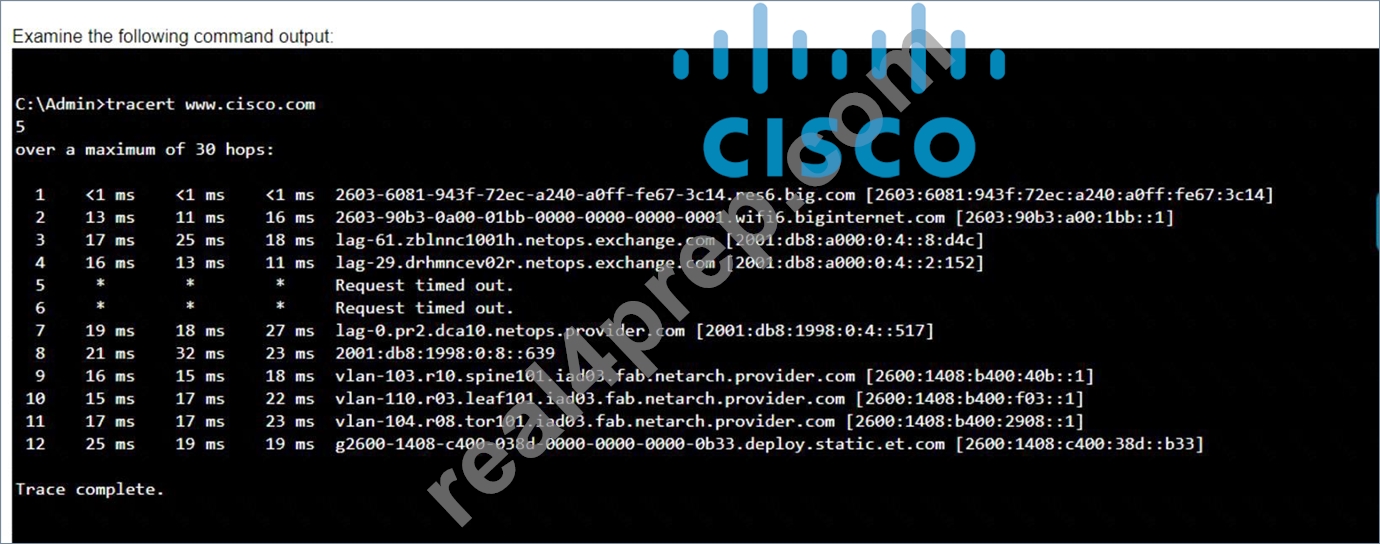
Which two conclusions can you make from the output of the tracert command? (Choose 2.) Note: You will receive partial credit for each correct answer.
- A. The routers at hops 5 and 6 are offline.
- B. The trace failed after the fourth hop.
- C. The IPv6 address associated with the www.cisco.com server is 2600:1408: c400: 38d: : b33.
- D. The device sending the trace has IPv6 address 2600:1408:c400:38d :: b33.
- E. The trace successfully reached the www.cisco.com server.
Answer: C,E
Explanation:
*Statement A: "The trace successfully reached the www.cisco.com server." This is true as indicated by the
"Trace complete" message at the end, showing that the trace has reached its destination.
*Statement C: "The IPv6 address associated with the www.cisco.com server is 2600:1408:c400:38d::b33." This is true because the final hop in the trace, which is the destination, has this IPv6 address.
*Statement B: "The trace failed after the fourth hop." This is incorrect as the trace continues beyond the fourth hop, despite some intermediate timeouts.
*Statement D: "The routers at hops 5 and 6 are offline." This is not necessarily true. The routers might be configured to not respond to traceroute requests.
*Statement E: "The device sending the trace has IPv6 address 2600:1408:c400:38d::b33." This is incorrect; this address belongs to the destination server, not the sender.
References:
*Understanding Traceroute: Traceroute Guide
NEW QUESTION # 32
An app on a user's computer is having problems downloading data. The app uses the following URL to download data:
https://www.companypro.net:7100/api
You need to use Wireshark to capture packets sent to and received from that URL.
Which Wireshark filter options would you use to filter the results? Complete the command by selecting the correct option from each drop-down list.
Note: You will receive partial credit for each correct selection.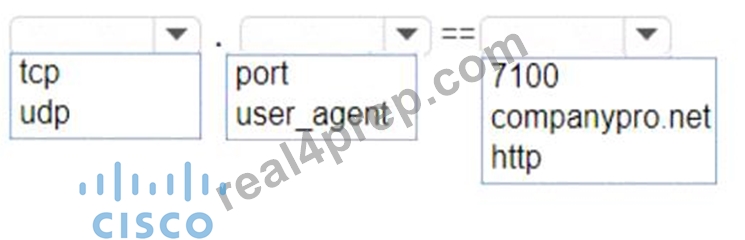
Answer:
Explanation: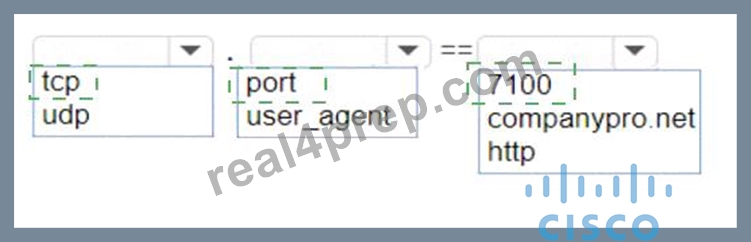
Explanation:
To capture packets sent to and received from the URLhttps://www.companypro.net:7100/apiusing Wireshark, you would use the following filter options:
* Protocol:tcp
* Filter Type:port
* Port Number:7100
This filter setup in Wireshark will display all TCP packets that are sent to or received from port 7100, which is the port specified in the URL for the API service. Since HTTPS typically uses TCP as the transport layer protocol, filtering by TCP and the specific port number will help isolate the relevant packets for troubleshooting the app's data download issues.
* cp: The app is using HTTPS, which relies on the TCP protocol for communication.
* port: The specific port number used by the application, which in this case is 7100.
* 7100: This is the port specified in the URL (https://www.companypro.net:7100/api).
This filter will capture all TCP traffic on port 7100, allowing you to analyze the packets related to the application's data download.
References:
* Wireshark Filters: Wireshark Display Filters
NEW QUESTION # 33
Which protocol allows you to securely upload files to another computer on the internet?
- A. HTTP
- B. ICMP
- C. SFTP
- D. NTP
Answer: C
Explanation:
SFTP, or Secure File Transfer Protocol, is a protocol that allows for secure file transfer capabilities between networked hosts. It is a secure extension of the File Transfer Protocol (FTP). SFTP encrypts both commands and data, preventing passwords and sensitive information from being transmitted openly over the network. It is typically used for secure file transfers over the internet and is built on the Secure Shell (SSH) protocol1.
References :=
*What Is SFTP? (Secure File Transfer Protocol)
*How to Use SFTP to Safely Transfer Files: A Step-by-Step Guide
*Secure File Transfers: Best Practices, Protocols And Tools
The Secure File Transfer Protocol (SFTP) is a secure version of the File Transfer Protocol (FTP) that uses SSH (Secure Shell) to encrypt all commands and data. This ensures that sensitive information, such as usernames, passwords, and files being transferred, are securely transmitted over the network.
*ICMP (Internet Control Message Protocol) is used for network diagnostics and is not designed for file transfer.
*NTP (Network Time Protocol) is used to synchronize clocks between computer systems and is not related to file transfer.
*HTTP (HyperText Transfer Protocol) is used for transmitting web pages over the internet and does not inherently provide secure file transfer capabilities.
Thus, the correct protocol that allows secure uploading of files to another computer on the internet is SFTP.
References :=
*Cisco Learning Network
*SFTP Overview (Cisco)
NEW QUESTION # 34
Examine the connections shown in the following image. Move the cable types on the right to the appropriate connection description on the left. You may use each cable type more than once or not at all.
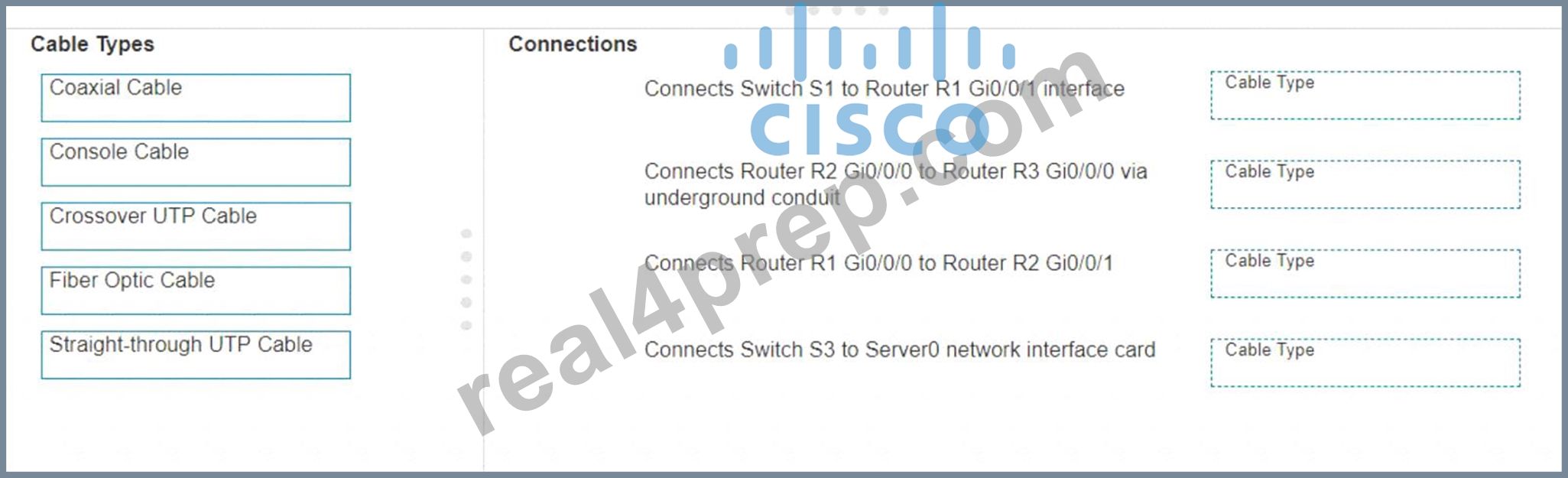
Answer:
Explanation:
Explanation:
Based on the image description provided, here are the cable types matched with the appropriate connection descriptions:
Connects Switch S1 to Router R1 Gi0/0/1 interfaceCable Type: = Straight-through UTP Cable Connects Router R2 Gi0/0/0 to Router R3 Gi0/0/0 via underground conduitCable Type: = Fiber Optic Cable Connects Router R1 Gi0/0/0 to Router R2 Gi0/0/1Cable Type: = Crossover UTP Cable Connects Switch S3 to Server0 network interface cardCable Type: = Straight-through UTP Cable The choices are based on standard networking practices where:
* Straight-through UTP cablesare typically used to connect a switch to a router or a network interface card.
* Fiber optic cablesare ideal for long-distance, high-speed data transmission, such as connections through an underground conduit.
* Crossover UTP cablesare used to connect similar devices, such as router-to-router connections.
These matches are consistent with the color-coded cables in the image: green for switch connections, yellow for router-to-router connections within the same rack, and blue for inter-rack connections. The use of these cables follows the Ethernet cabling standards.
* Connects Switch S1 to Router R1 Gi0/0/1 interface:
* Cable Type: Straight-through UTP Cable
* Explanation: A straight-through UTP cable is typically used to connect different types of devices, such as a switch to a router.
* Connects Router R2 Gi0/0/0 to Router R3 Gi0/0/0 via underground conduit:
* Cable Type: Fiber Optic Cable
* Explanation: Fiber optic cables are used for long-distance connections, such as those through an underground conduit between buildings.
* Connects Router R1 Gi0/0/0 to Router R2 Gi0/0/1:
* Cable Type: Crossover UTP Cable
* Explanation: A crossover UTP cable is typically used to connect similar devices directly, such as router to router connections.
* Connects Switch S3 to Server0 network interface card:
* Cable Type: Straight-through UTP Cable
* Explanation: A straight-through UTP cable is typically used to connect a switch to an end device, such as a server.
* Straight-through UTP Cable: Used to connect different devices (e.g., switch to router, switch to server).
* Crossover UTP Cable: Used to connect similar devices directly (e.g., router to router, switch to switch).
* Fiber Optic Cable: Used for long-distance and high-speed connections, often between buildings or data centers.
References:
* Network Cable Types and Uses: Cisco Network Cables
* Understanding Ethernet Cabling: Ethernet Cable Guide
NEW QUESTION # 35
Which component of the AAA service security model provides identity verification?
- A. Auditing
- B. Authorization
- C. Authentication
- D. Accounting
Answer: C
Explanation:
The AAA service security model consists of three components: Authentication, Authorization, and Accounting.
*Authentication: This is the process of verifying the identity of a user or device. It ensures that only legitimate users can access the network or service.
*Authorization: This determines what an authenticated user is allowed to do or access within the network.
*Auditing/Accounting: This component tracks the actions of the user, including what resources they access and what changes they make.
Thus, the correct answer is C. Authentication.
References :=
*Cisco AAA Overview
*Understanding AAA (Authentication, Authorization, and Accounting)
NEW QUESTION # 36
......
CCST-Networking exam questions for practice in 2024 Updated 42 Questions: https://lead2pass.real4prep.com/CCST-Networking-exam.html