


New (2024) ISTQB CT-AI Exam Dumps
Best Way To Study For ISTQB CT-AI Exam Brilliant CT-AI Exam Questions PDF
ISTQB CT-AI Exam Syllabus Topics:
| Topic | Details |
|---|---|
| Topic 1 |
|
| Topic 2 |
|
| Topic 3 |
|
| Topic 4 |
|
| Topic 5 |
|
| Topic 6 |
|
| Topic 7 |
|
| Topic 8 |
|
| Topic 9 |
|
| Topic 10 |
|
| Topic 11 |
|
NEW QUESTION # 21
Which ONE of the following activities is MOST relevant when addressing the scenario where you have more than the required amount of data available for the training?
SELECT ONE OPTION
- A. Data augmentation
- B. Data labeling
- C. Data sampling
- D. Feature selection
Answer: C
Explanation:
A . Feature selection
Feature selection is the process of selecting the most relevant features from the data. While important, it is not directly about handling excess data.
B . Data sampling
Data sampling involves selecting a representative subset of the data for training. When there is more data than needed, sampling can be used to create a manageable dataset that maintains the statistical properties of the full dataset.
C . Data labeling
Data labeling involves annotating data for supervised learning. It is necessary for training models but does not address the issue of having excess data.
D . Data augmentation
Data augmentation is used to increase the size of the training dataset by creating modified versions of existing data. It is useful when there is insufficient data, not when there is excess data.
Therefore, the correct answer is B because data sampling is the most relevant activity when dealing with an excess amount of data for training.
NEW QUESTION # 22
Which ONE of the following options describes a scenario of A/B testing the LEAST?
SELECT ONE OPTION
- A. A comparison of two different websites for the same company to observe from a user acceptance perspective.
- B. A comparison of two different offers in a recommendation system to decide on the more effective offer for same users.
- C. A comparison of the performance of an ML system on two different input datasets.
- D. A comparison of the performance of two different ML implementations on the same input data.
Answer: C
Explanation:
A/B testing, also known as split testing, is a method used to compare two versions of a product or system to determine which one performs better. It is widely used in web development, marketing, and machine learning to optimize user experiences and model performance. Here's why option C is the least descriptive of an A/B testing scenario:
Understanding A/B Testing:
In A/B testing, two versions (A and B) of a system or feature are tested against each other. The objective is to measure which version performs better based on predefined metrics such as user engagement, conversion rates, or other performance indicators.
Application in Machine Learning:
In ML systems, A/B testing might involve comparing two different models, algorithms, or system configurations on the same set of data to observe which yields better results.
Why Option C is the Least Descriptive:
Option C describes comparing the performance of an ML system on two different input datasets. This scenario focuses on the input data variation rather than the comparison of system versions or features, which is the essence of A/B testing. A/B testing typically involves a controlled experiment with two versions being tested under the same conditions, not different datasets.
Clarifying the Other Options:
A . A comparison of two different websites for the same company to observe from a user acceptance perspective: This is a classic example of A/B testing where two versions of a website are compared.
B . A comparison of two different offers in a recommendation system to decide on the more effective offer for the same users: This is another example of A/B testing in a recommendation system.
D . A comparison of the performance of two different ML implementations on the same input data: This fits the A/B testing model where two implementations are compared under the same conditions.
Reference:
ISTQB CT-AI Syllabus, Section 9.4, A/B Testing, explains the methodology and application of A/B testing in various contexts.
"Understanding A/B Testing" (ISTQB CT-AI Syllabus).
NEW QUESTION # 23
Which ONE of the following options does NOT describe an Al technology related characteristic which differentiates Al test environments from other test environments?
SELECT ONE OPTION
- A. Challenges resulting from low accuracy of the models.
- B. Challenges in the creation of scenarios of human handover for autonomous systems.
- C. The challenge of mimicking undefined scenarios generated due to self-learning
- D. The challenge of providing explainability to the decisions made by the system.
Answer: B
Explanation:
AI test environments have several unique characteristics that differentiate them from traditional test environments. Let's evaluate each option:
A . Challenges resulting from low accuracy of the models.
Low accuracy is a common challenge in AI systems, especially during initial development and training phases. Ensuring the model performs accurately in varied and unpredictable scenarios is a critical aspect of AI testing.
B . The challenge of mimicking undefined scenarios generated due to self-learning.
AI systems, particularly those that involve machine learning, can generate undefined or unexpected scenarios due to their self-learning capabilities. Mimicking and testing these scenarios is a unique challenge in AI environments.
C . The challenge of providing explainability to the decisions made by the system.
Explainability, or the ability to understand and articulate how an AI system arrives at its decisions, is a significant and unique challenge in AI testing. This is crucial for trust and transparency in AI systems.
D . Challenges in the creation of scenarios of human handover for autonomous systems.
While important, the creation of scenarios for human handover in autonomous systems is not a characteristic unique to AI test environments. It is more related to the operational and deployment challenges of autonomous systems rather than the intrinsic technology-related characteristics of AI .
Given the above points, option D is the correct answer because it describes a challenge related to operational deployment rather than a technology-related characteristic unique to AI test environments.
NEW QUESTION # 24
A software component uses machine learning to recognize the digits from a scan of handwritten numbers. In the scenario above, which type of Machine Learning (ML) is this an example of?
SELECT ONE OPTION
- A. Regression
- B. Clustering
- C. Classification
- D. Reinforcement learning
Answer: C
Explanation:
Recognizing digits from a scan of handwritten numbers using machine learning is an example of classification. Here's a breakdown:
Classification: This type of machine learning involves categorizing input data into predefined classes. In this scenario, the input data (handwritten digits) are classified into one of the 10 digit classes (0-9).
Why Not Other Options:
Reinforcement Learning: This involves learning by interacting with an environment to achieve a goal, which does not fit the problem of recognizing digits.
Regression: This is used for predicting continuous values, not discrete categories like digit recognition.
Clustering: This involves grouping similar data points together without predefined classes, which is not the case here.
NEW QUESTION # 25
"Splendid Healthcare" has started developing a cancer detection system based on ML. The type of cancer they plan on detecting has 2% prevalence rate in the population of a particular geography. It is required that the model performs well for both normal and cancer patients.
Which ONE of the following combinations requires MAXIMIZATION?
SELECT ONE OPTION
- A. Maximize specificity number of classes
- B. Maximize accuracy and recall
- C. Maximize recall and precision
- D. Maximize precision and accuracy
Answer: C
Explanation:
Prevalence Rate and Model Performance:
The cancer detection system being developed by "Splendid Healthcare" needs to account for the fact that the type of cancer has a 2% prevalence rate in the population. This indicates that the dataset is highly imbalanced with far fewer positive (cancer) cases compared to negative (normal) cases.
Importance of Recall:
Recall, also known as sensitivity or true positive rate, measures the proportion of actual positive cases that are correctly identified by the model. In medical diagnosis, especially cancer detection, recall is critical because missing a positive case (false negative) could have severe consequences for the patient. Therefore, maximizing recall ensures that most, if not all, cancer cases are detected.
Importance of Precision:
Precision measures the proportion of predicted positive cases that are actually positive. High precision reduces the number of false positives, meaning fewer people will be incorrectly diagnosed with cancer. This is also important to avoid unnecessary anxiety and further invasive testing for those who do not have the disease.
Balancing Recall and Precision:
In scenarios where both false negatives and false positives have significant consequences, it is crucial to balance recall and precision. This balance ensures that the model is not only good at detecting positive cases but also accurate in its predictions, reducing both types of errors.
Accuracy and Specificity:
While accuracy (the proportion of total correct predictions) is important, it can be misleading in imbalanced datasets. In this case, high accuracy could simply result from the model predicting the majority class (normal) correctly. Specificity (true negative rate) is also important, but for a cancer detection system, recall and precision take precedence to ensure positive cases are correctly and accurately identified.
Conclusion:
Therefore, for a cancer detection system with a low prevalence rate, maximizing both recall and precision is crucial to ensure effective and accurate detection of cancer cases.
NEW QUESTION # 26
Which ONE of the following options BEST DESCRIBES clustering?
SELECT ONE OPTION
- A. Clustering is classification of a continuous quantity.
- B. Clustering is done without prior knowledge of output classes.
- C. Clustering requires you to know the classes.
- D. Clustering is supervised learning.
Answer: B
Explanation:
Clustering is a type of machine learning technique used to group similar data points into clusters. It is a key concept in unsupervised learning, where the algorithm tries to find patterns or groupings in data without prior knowledge of output classes. Let's analyze each option:
A . Clustering is classification of a continuous quantity.
This is incorrect. Classification typically involves discrete categories, whereas clustering involves grouping similar data points. Classification of continuous quantities is generally referred to as regression.
B . Clustering is supervised learning.
This is incorrect. Clustering is an unsupervised learning technique because it does not rely on labeled data.
C . Clustering is done without prior knowledge of output classes.
This is correct. In clustering, the algorithm groups data points into clusters without any prior knowledge of the classes. It discovers the inherent structure in the data.
D . Clustering requires you to know the classes.
This is incorrect. Clustering does not require prior knowledge of classes. Instead, it aims to identify and form the classes or groups based on the data itself.
Therefore, the correct answer is C because clustering is an unsupervised learning technique done without prior knowledge of output classes.
NEW QUESTION # 27
Which ONE of the following tests is LEAST likely to be performed during the ML model testing phase?
SELECT ONE OPTION
- A. Testing the API of the service powered by the ML model.
- B. Testing the speed of the training of the model.
- C. Testing the speed of the prediction by the model.
- D. Testing the accuracy of the classification model.
Answer: B
Explanation:
The question asks which test is least likely to be performed during the ML model testing phase. Let's consider each option:
Testing the accuracy of the classification model (A): Accuracy testing is a fundamental part of the ML model testing phase. It ensures that the model correctly classifies the data as intended and meets the required performance metrics.
Testing the API of the service powered by the ML model (B): Testing the API is crucial, especially if the ML model is deployed as part of a service. This ensures that the service integrates well with other systems and that the API performs as expected.
Testing the speed of the training of the model (C): This is least likely to be part of the ML model testing phase. The speed of training is more relevant during the development phase when optimizing and tuning the model. During testing, the focus is more on the model's performance and behavior rather than how quickly it was trained.
Testing the speed of the prediction by the model (D): Testing the speed of prediction is important to ensure that the model meets performance requirements in a production environment, especially for real-time applications.
Reference:
ISTQB CT-AI Syllabus Section 3.2 on ML Workflow and Section 5 on ML Functional Performance Metrics discuss the focus of testing during the model testing phase, which includes accuracy and prediction speed but not the training speed.
NEW QUESTION # 28
An image classification system is being trained for classifying faces of humans. The distribution of the data is 70% ethnicity A and 30% for ethnicities B, C and D. Based ONLY on the above information, which of the following options BEST describes the situation of this image classification system?
SELECT ONE OPTION
- A. This is an example of algorithmic bias.
- B. This is an example of sample bias.
- C. This is an example of hyperparameter bias.
- D. This is an example of expert system bias.
Answer: B
Explanation:
A . This is an example of expert system bias.
Expert system bias refers to bias introduced by the rules or logic defined by experts in the system, not by the data distribution.
B . This is an example of sample bias.
Sample bias occurs when the training data is not representative of the overall population that the model will encounter in practice. In this case, the over-representation of ethnicity A (70%) compared to B, C, and D (30%) creates a sample bias, as the model may become biased towards better performance on ethnicity A.
C . This is an example of hyperparameter bias.
Hyperparameter bias relates to the settings and configurations used during the training process, not the data distribution itself.
D . This is an example of algorithmic bias.
Algorithmic bias refers to biases introduced by the algorithmic processes and decision-making rules, not directly by the distribution of training data.
Based on the provided information, option B (sample bias) best describes the situation because the training data is skewed towards ethnicity A, potentially leading to biased model performance.
NEW QUESTION # 29
ln the near future, technology will have evolved, and Al will be able to learn multiple tasks by itself without needing to be retrained, allowing it to operate even in new environments. The cognitive abilities of Al are similar to a child of 1-2 years.' In the above quote, which ONE of the following options is the correct name of this type of Al?
SELECT ONE OPTION
- A. General Al
- B. Super Al
- C. Narrow Al
- D. Technological singularity
Answer: A
Explanation:
* A. Technological singularity
Technological singularity refers to a hypothetical point in the future when AI surpasses human intelligence and can continuously improve itself without human intervention. This scenario involves capabilities far beyond those described in the question.
* B. Narrow AI
Narrow AI, also known as weak AI, is designed to perform a specific task or a narrow range of tasks. It does not have general cognitive abilities and cannot learn multiple tasks by itself without retraining.
* C. Super AI
Super AI refers to an AI that surpasses human intelligence and capabilities across all fields. This is an advanced concept and not aligned with the description of having cognitive abilities similar to a young child.
* D. General AI
General AI, or strong AI, has the ability to understand, learn, and apply knowledge across a wide range of tasks, similar to human cognitive abilities. It aligns with the description of AI that can learn multiple tasks and operate in new environments without needing retraining.
NEW QUESTION # 30
Which ONE of the following options is an example that BEST describes a system with Al-based autonomous functions?
SELECT ONE OPTION
- A. A system that utilizes a tool like Selenium.
- B. A system that is fully able to respond to its environment.
- C. A system that utilizes human beings for all important decisions.
- D. A fully automated manufacturing plant that uses no software.
Answer: B
Explanation:
* AI-Based Autonomous Functions: An AI-based autonomous system is one that can respond to its environment without human intervention. The other options either involve human decisions or do not use AI at all.
* Reference: ISTQB_CT-AI_Syllabus_v1.0, Sections on Autonomy and Testing Autonomous AI-Based Systems.
NEW QUESTION # 31
Which ONE of the following hardware is MOST suitable for implementing Al when using ML?
SELECT ONE OPTION
- A. 64-bit CPUs.
- B. Hardware supporting fast matrix multiplication.
- C. High powered CPUs.
- D. Hardware supporting high precision floating point operations.
Answer: B
Explanation:
A . 64-bit CPUs.
While 64-bit CPUs are essential for handling large amounts of memory and performing complex computations, they are not specifically optimized for the types of operations commonly used in machine learning.
B . Hardware supporting fast matrix multiplication.
Matrix multiplication is a fundamental operation in many machine learning algorithms, especially in neural networks and deep learning. Hardware optimized for fast matrix multiplication, such as GPUs (Graphics Processing Units), is most suitable for implementing AI and ML because it can handle the parallel processing required for these operations efficiently.
C . High powered CPUs.
High powered CPUs are beneficial for general-purpose computing tasks and some aspects of ML, but they are not as efficient as specialized hardware like GPUs for matrix multiplication and other ML-specific tasks.
D . Hardware supporting high precision floating point operations.
High precision floating point operations are important for scientific computing and some specific AI tasks, but for many ML applications, fast matrix multiplication is more critical than high precision alone.
Therefore, the correct answer is B because hardware supporting fast matrix multiplication, such as GPUs, is most suitable for the parallel processing requirements of machine learning.
NEW QUESTION # 32
Written requirements are given in text documents, which ONE of the following options is the BEST way to generate test cases from these requirements?
SELECT ONE OPTION
- A. GUI analysis by computer vision
- B. Natural language processing on textual requirements
- C. Machine learning on logs of execution
- D. Analyzing source code for generating test cases
Answer: B
Explanation:
When written requirements are given in text documents, the best way to generate test cases is by using Natural Language Processing (NLP). Here's why:
Natural Language Processing (NLP): NLP can analyze and understand human language. It can be used to process textual requirements to extract relevant information and generate test cases. This method is efficient in handling large volumes of textual data and identifying key elements necessary for testing.
Why Not Other Options:
Analyzing source code for generating test cases: This is more suitable for white-box testing where the code is available, but it doesn't apply to text-based requirements.
Machine learning on logs of execution: This approach is used for dynamic analysis based on system behavior during execution rather than static textual requirements.
GUI analysis by computer vision: This is used for testing graphical user interfaces and is not applicable to text-based requirements.
NEW QUESTION # 33
Which of the following is THE LEAST appropriate tests to be performed for testing a feature related to autonomy?
SELECT ONE OPTION
- A. Test for human handover after a given time interval.
- B. Test for human handover when it should actually not be relinquishing control.
- C. Test for human handover requiring mandatory relinquishing control.
- D. Test for human handover to give rest to the system.
Answer: B
Explanation:
* Testing Autonomy: Testing for human handover when it should not be relinquishing control is the least appropriate because it contradicts the very definition of autonomous systems. The other tests are relevant to ensuring smooth operation and transitions between human and AI control.
* Reference: ISTQB_CT-AI_Syllabus_v1.0, Sections on Testing Autonomous AI-Based Systems and Testing for Human-AI Interaction.
NEW QUESTION # 34
The activation value output for a neuron in a neural network is obtained by applying computation to the neuron.
Which ONE of the following options BEST describes the inputs used to compute the activation value?
SELECT ONE OPTION
- A. Individual bias at the neuron level, and activation values of neurons in the previous layer.
- B. Individual bias at the neuron level, and weights assigned to the connections between the neurons.
- C. Activation values of neurons in the previous layer, and weights assigned to the connections between the neurons.
- D. Individual bias at the neuron level, activation values of neurons in the previous layer, and weights assigned to the connections between the neurons.
Answer: D
Explanation:
In a neural network, the activation value of a neuron is determined by a combination of inputs from the previous layer, the weights of the connections, and the bias at the neuron level. Here's a detailed breakdown:
Inputs for Activation Value:
Activation Values of Neurons in the Previous Layer: These are the outputs from neurons in the preceding layer that serve as inputs to the current neuron.
Weights Assigned to the Connections: Each connection between neurons has an associated weight, which determines the strength and direction of the input signal.
Individual Bias at the Neuron Level: Each neuron has a bias value that adjusts the input sum, allowing the activation function to be shifted.
Calculation:
The activation value is computed by summing the weighted inputs from the previous layer and adding the bias.
Formula: z=∑(wiai)+bz = \sum (w_i \cdot a_i) + bz=∑(wiai)+b, where wiw_iwi are the weights, aia_iai are the activation values from the previous layer, and bbb is the bias.
The activation function (e.g., sigmoid, ReLU) is then applied to this sum to get the final activation value.
Why Option A is Correct:
Option A correctly identifies all components involved in computing the activation value: the individual bias, the activation values of the previous layer, and the weights of the connections.
Eliminating Other Options:
B . Activation values of neurons in the previous layer, and weights assigned to the connections between the neurons: This option misses the bias, which is crucial.
C . Individual bias at the neuron level, and weights assigned to the connections between the neurons: This option misses the activation values from the previous layer.
D . Individual bias at the neuron level, and activation values of neurons in the previous layer: This option misses the weights, which are essential.
Reference:
ISTQB CT-AI Syllabus, Section 6.1, Neural Networks, discusses the components and functioning of neurons in a neural network.
"Neural Network Activation Functions" (ISTQB CT-AI Syllabus, Section 6.1.1).
NEW QUESTION # 35
Upon testing a model used to detect rotten tomatoes, the following data was observed by the test engineer, based on certain number of tomato images.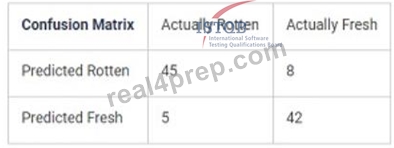
For this confusion matrix which combinations of values of accuracy, recall, and specificity respectively is CORRECT?
SELECT ONE OPTION
- A. 1,0.9, 0.8
- B. 1,0.87,0.84
- C. 0.84.1,0.9
- D. 0.87.0.9. 0.84
Answer: D
Explanation:
To calculate the accuracy, recall, and specificity from the confusion matrix provided, we use the following formulas:
Confusion Matrix:
Actually Rotten: 45 (True Positive), 8 (False Positive)
Actually Fresh: 5 (False Negative), 42 (True Negative)
Accuracy:
Accuracy is the proportion of true results (both true positives and true negatives) in the total population.
Formula: Accuracy=TP+TNTP+TN+FP+FN\text{Accuracy} = \frac{TP + TN}{TP + TN + FP + FN}Accuracy=TP+TN+FP+FNTP+TN Calculation: Accuracy=45+4245+42+8+5=87100=0.87\text{Accuracy} = \frac{45 + 42}{45 + 42 + 8 + 5} = \frac{87}{100} = 0.87Accuracy=45+42+8+545+42=10087=0.87 Recall (Sensitivity):
Recall is the proportion of true positive results in the total actual positives.
Formula: Recall=TPTP+FN\text{Recall} = \frac{TP}{TP + FN}Recall=TP+FNTP Calculation: Recall=4545+5=4550=0.9\text{Recall} = \frac{45}{45 + 5} = \frac{45}{50} = 0.9Recall=45+545=5045=0.9 Specificity:
Specificity is the proportion of true negative results in the total actual negatives.
Formula: Specificity=TNTN+FP\text{Specificity} = \frac{TN}{TN + FP}Specificity=TN+FPTN Calculation: Specificity=4242+8=4250=0.84\text{Specificity} = \frac{42}{42 + 8} = \frac{42}{50} = 0.84Specificity=42+842=5042=0.84 Therefore, the correct combinations of accuracy, recall, and specificity are 0.87, 0.9, and 0.84 respectively.
Reference:
ISTQB CT-AI Syllabus, Section 5.1, Confusion Matrix, provides detailed formulas and explanations for calculating various metrics including accuracy, recall, and specificity.
"ML Functional Performance Metrics" (ISTQB CT-AI Syllabus, Section 5).
NEW QUESTION # 36
Which ONE of the following approaches to labelling requires the least time and effort?
SELECT ONE OPTION
- A. Pre-labeled dataset
- B. Outsourced
- C. Al-Assisted
- D. Internal
Answer: A
Explanation:
* Labelling Approaches: Among the options provided, pre-labeled datasets require the least time and effort because the data has already been labeled, eliminating the need for further manual or automated labeling efforts.
* Reference: ISTQB_CT-AI_Syllabus_v1.0, Section 4.5 Data Labelling for Supervised Learning, which discusses various approaches to data labeling, including pre-labeled datasets, and their associated time and effort requirements.
NEW QUESTION # 37
......
Updated Verified Pass CT-AI Exam - Real Questions and Answers: https://lead2pass.real4prep.com/CT-AI-exam.html