


[Jul 03, 2026] Get New CAS-004 Certification Practice Test Questions Exam Dumps
Real CAS-004 Exam Dumps Questions Valid CAS-004 Dumps PDF
The CASP+ certification is recognized globally and is highly regarded by employers in the IT industry. Achieving this certification demonstrates that the candidate has advanced-level security knowledge and skills and is capable of designing and implementing secure solutions in complex enterprise environments. CompTIA Advanced Security Practitioner (CASP+) Exam certification is ideal for those who aspire to advance their careers in IT security and want to demonstrate their expertise in enterprise security, risk management, research and analysis, and integration of computing, communications, and business disciplines.
To prepare for the CASP+ exam, candidates should have a deep understanding of cybersecurity principles and best practices. They should also have experience in implementing secure solutions across a variety of enterprise environments. Candidates can prepare for the exam through self-study, online courses, or in-person training programs.
CompTIA CASP+ certification exam is an advanced-level certification designed for cybersecurity professionals who have extensive experience in the field. CompTIA Advanced Security Practitioner (CASP+) Exam certification is designed to validate the candidate's knowledge and skills in advanced-level cybersecurity concepts and practices and to demonstrate to employers that they have the expertise required to design, implement, and manage cybersecurity solutions at the enterprise level. CompTIA Advanced Security Practitioner (CASP+) Exam certification covers a range of topics that are relevant to the day-to-day work of cybersecurity professionals and is designed to be practical and relevant to real-world scenarios.
NEW QUESTION # 265
A SOC analyst received an alert about a potential compromise and is reviewing the following SIEM logs: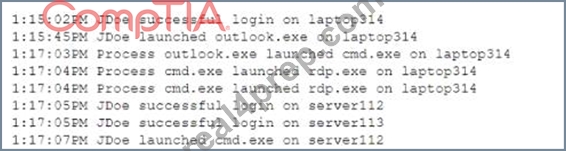
Which of the following is the most appropriate action for the SOC analyst to recommend?
- A. Disabling account JDoe to prevent further lateral movement
- B. Creating HIPS and NIPS rules to prevent logins
- C. Isolating laptop314 from the network
- D. Alerting JDoe about the potential account compromise
Answer: C
Explanation:
The SIEM logs indicate suspicious behavior that could be a sign of a compromise, such as the launching of cmd.exeafterOutlook.exe, which is atypical user behavior and could indicate that a machine has been compromised to perform lateral movement within the network. Isolatinglaptop314from the network would contain the threat and prevent any potential spread to other systems while further investigation takes place.
NEW QUESTION # 266
An organization recently completed a security controls assessment. The results highlighted the following vulnerabilities:
- Out-of-date definitions
- Misconfigured operating systems
- An inability to detect active attacks
- Unimpeded access to critical servers' USB ports
Which of the following will most likely reduce the risks that were identified by the assessment team?
- A. Create an information security program that addresses user training, perform weekly audits of user workstations, and utilize a centralized configuration management program.
- B. Implement a vulnerability management program and a SIEM tool with alerting, install a badge system with zones, and restrict privileged access.
- C. Update antivirus definitions, install NGFW with logging enabled, use USB port lockers, and run SCAP scans weekly.
- D. Install EDR on endpoints, configure group policy, lock server room doors, and install a camera system with guards watching 24/7.
Answer: C
NEW QUESTION # 267
An e-commerce company is running a web server on premises, and the resource utilization is usually less than
30%. During the last two holiday seasons, the server experienced performance issues because of too many connections, and several customers were not able to finalize purchase orders. The company is looking to change the server configuration to avoid this kind of performance issue.
Which of the following is the MOST cost-effective solution?
- A. Upgrade the server with a new one.
- B. Change the operating system.
- C. Move the server to a cloud provider.
- D. Buy a new server and create an active-active cluster.
Answer: C
Explanation:
Moving the server to a cloud provider is the most cost-effective solution to avoid performance issues caused by too many connections during peak seasons, such as holidays. Moving the server to a cloud provider can provide scalability, elasticity, and availability for the web server, as it can adjust its resources and capacity according to the demand and traffic. Moving the server to a cloud provider can also reduce operational and maintenance costs, as the cloud provider can handle the infrastructure and security aspects. Changing the operating system may not help avoid performance issues, as it could introduce compatibility or functionality problems, and it may not address the resource or capacity limitations. Buying a new server and creating an active-active cluster may help avoid performance issues, but it may not be cost-effective, as it could involve hardware and software expenses, as well as complex configuration and management tasks. Upgrading the server with a new one may help avoid performance issues, but it may not be cost-effective, as it could involve hardware and software expenses, as well as migration and testing efforts. Verified References: https://www.
comptia.org/blog/what-is-cloud-computing https://partners.comptia.org/docs/default-source/resources/casp-content-guide
NEW QUESTION # 268
A bank is working with a security architect to find the BEST solution to detect database management system compromises. The solution should meet the following requirements:
♦ Work at the application layer
♦ Send alerts on attacks from both privileged and malicious users
♦ Have a very low false positive
Which of the following should the architect recommend?
- A. DAM
- B. WAF
- C. NIPS
- D. UTM
- E. FIM
Answer: A
NEW QUESTION # 269
A security compliance requirement states that specific environments that handle sensitive data must be protected by need-to-know restrictions and can only connect to authorized endpoints. The requirement also states that a DLP solution within the environment must be used to control the data from leaving the environment.
Which of the following should be implemented for privileged users so they can support the environment from their workstations while remaining compliant?
- A. FIM on the servers storing the data
- B. A general VPN solution to the primary network
- C. A jump box in the screened subnet
- D. NAC to control authorized endpoints
Answer: D
Explanation:
Network Access Control (NAC) is used to bolster the network security by restricting the availability of network resources to managed endpoints that don't satisfy the compliance requirements of the Organization.
NEW QUESTION # 270
A company is migrating its data center to the cloud. Some hosts had been previously isolated, but a risk assessment convinced the engineering team to reintegrate the systems. Because the systems were isolated, the risk associated with vulnerabilities was low. Which of the following should the security team recommend be performed before migrating these servers to the cloud?
- A. Creating a honeypot and adding decoy files
- B. Implementing least functionality and time-based access
- C. Performing patching and hardening
- D. Deploying host and network IDS
Answer: C
Explanation:
Before migrating previously isolated systems to the cloud, it is essential to perform patching and hardening. These systems may have been neglected while isolated, so updating them with the latest security patches and applying hardening measures (such as disabling unnecessary services and implementing strict access controls) is crucial to reduce vulnerabilities. This ensures that the systems are secure before they are exposed to the wider cloud environment. CASP+ emphasizes the importance of securing systems through patch management and hardening before integrating them into more exposed environments like the cloud.
Reference:
CASP+ CAS-004 Exam Objectives: Domain 2.0 - Enterprise Security Operations (Patching, Hardening, and Cloud Migration Security) CompTIA CASP+ Study Guide: Securing and Hardening Systems Before Cloud Migration
NEW QUESTION # 271
A vulnerability analyst identified a zero-day vulnerability in a company's internally developed software.
Since the current vulnerability management system does not have any checks for this vulnerability, an engineer has been asked to create one.
Which of the following would be BEST suited to meet these requirements?
- A. Node.js
- B. ARF
- C. ISACs
- D. OVAL
Answer: D
Explanation:
OVAL (Open Vulnerability and Assessment Language) is a standard that would be best suited for creating checks for a zero-day vulnerability in an organization's internally developed software. OVAL is a standard for expressing system configuration information and vulnerabilities in an XML format, allowing interoperability and automation among different security tools and platforms. An engineer can use OVAL to create definitions or tests for specific vulnerabilities or states in the software, and then use OVAL-compatible tools to scan or evaluate the software against those definitions or tests. ARF (Asset Reporting Format) is not a standard for creating checks for vulnerabilities, but a standard for expressing information about assets and their characteristics in an XML format, allowing interoperability and automation among different security tools and platforms. ISACs (Information Sharing and Analysis Centers) are not standards for creating checks for vulnerabilities, but organizations that collect, analyze, and disseminate information about threats, vulnerabilities, incidents, or best practices among different sectors or communities. Node.js is not a standard for creating checks for vulnerabilities, but a runtime environment that allows executing JavaScript code outside of a web browser, enabling the development of scalable web applications or services. Verified References: https://www.comptia.org/blog/what-is-oval https://partners.comptia.org/docs/default-source
/resources/casp-content-guide
NEW QUESTION # 272
While investigating a security event, an analyst finds evidence that a user opened an email attachment from an unknown source. Shortly after the user opened the attachment, a group of servers experienced a large amount of network and resource activity. Upon investigating the servers, the analyst discovers the servers were encrypted by ransomware that is demanding payment within 48 hours or all data will be destroyed. The company has no response plans for ransomware.
Which of the following is the NEXT step the analyst should take after reporting the incident to the management team?
- A. Isolate the servers to prevent the spread.
- B. Pay the ransom within 48 hours.
- C. Request that the affected servers be restored immediately.
- D. Notify law enforcement.
Answer: A
Explanation:
Isolating the servers is the best immediate action to take after reporting the incident to the management team, as it can limit the damage and contain the ransomware infection. Paying the ransom is not advisable, as it does not guarantee the recovery of the data and may encourage further attacks. Notifying law enforcement is a possible step, but not the next one after reporting. Requesting that the affected servers be restored immediately may not be feasible or effective, as it depends on the availability and integrity of backups, and it does not address the root cause of the attack. Verified References: https://www.comptia.org/blog/what-is- ransomware-and-how-to-protect-yourself https://www.comptia.org/certifications/comptia-advanced-security- practitioner
NEW QUESTION # 273
A company is moving most of its customer-facing production systems to the cloud-facing production systems to the cloud. IaaS is the service model being used. The Chief Executive Officer is concerned about the type of encryption available and requires the solution must have the highest level of security.
Which of the following encryption methods should the cloud security engineer select during the implementation phase?
- A. Proxy-based
- B. Storage-based
- C. Instance-based
- D. Array controller-based
Answer: B
Explanation:
Explanation
We recommend that you encrypt your virtual hard disks (VHDs) to help protect your boot volume and data volumes at rest in storage, along with your encryption keys and secrets. Azure Disk Encryption helps you encrypt your Windows and Linux IaaS virtual machine disks. Azure Disk Encryption uses the industry-standard BitLocker feature of Windows and the DM-Crypt feature of Linux to provide volume encryption for the OS and the data disks. The solution is integrated with Azure Key Vault to help you control and manage the disk-encryption keys and secrets in your key vault subscription. The solution also ensures that all data on the virtual machine disks are encrypted at rest in Azure Storage.https://docs.microsoft.com/en-us/azure/security/fundamentals/iaas
NEW QUESTION # 274
A company with multiple locations has taken a cloud-only approach to its infrastructure. The company does not have standard vendors or systems, resulting in a mix of various solutions put in place by each location. The Chief Information Security Officer wants to ensure that the internal security team has visibility into all platforms. Which of the following best meets this objective?
- A. Security information and event management
- B. Cloud security posture management
- C. Managed detection and response services from a third party
- D. SNMPv2 monitoring and log aggregation
Answer: A
Explanation:
Security Information and Event Management (SIEM) systems provide real-time analysis of security alerts generated by applications and network hardware. SIEMs are beneficial in environments where there is a mix of various solutions, as they can collect and aggregate logs from multiple sources, providing the internal security team with a centralized view and visibility into all platforms. This would best meet the objective of ensuring visibility into all platforms, regardless of the differing solutions across the company's locations.
NEW QUESTION # 275
A systems administrator is preparing to run avulnerability scanon a set of information systems in the organization. The systems administrator wants to ensure that the targeted systems produceaccurate information, especially regardingconfiguration settings. Which of the following scan types will provide the systems administrator with themost accurate information?
- A. A passive, credentialed scan
- B. An active, non-credentialed scan
- C. An active, credentialed scan
- D. A passive, non-credentialed scan
Answer: C
Explanation:
Comprehensive and Detailed in-Depth Explanation:
Understanding Vulnerability Scanning Types:
Vulnerability scans can be categorized by two major factors:
Active vs. Passive:
Active Scans:Actively probe the target system, gathering detailed data.
Passive Scans:Monitor network traffic and analyze data without directly probing the system.
Credentialed vs. Non-Credentialed:
Credentialed Scans:Utilize valid user credentials to access system information.
Non-Credentialed Scans:Rely on publicly accessible data and network probing.
Why the Correct Answer is D (An active, credentialed scan):
Anactive, credentialed scancombinesdirect system probingwithauthorized access.
This scan type provides themost accurate and comprehensive data, including:
Configuration settings:Verifies security configurations likefirewall rules, user privileges, and patch levels.
Detailed vulnerability data:Can accessinternal system informationandlog files.
Thorough system analysis:Can enumeratesoftware versions, system settings, and misconfigurations.
Credentialed scans canaccess local configuration filesandOS-level data, giving afull pictureof the system's security posture.
Example Scenario:
A systems administrator wants to verify thatall systems are patchedand properly configured according tocompany policies.
Anactive, credentialed scancan log into each system anddirectly check patch versionsandconfiguration files, while anon-credentialed scanwould only be able to detect open ports and basic system information.
Why the Other Options Are Incorrect:
A: A passive, credentialed scan:
Passive scansdo not interact directlywith the system, even if credentials are available.
Theylack accuracyin identifyingconfiguration settingssince they onlymonitor traffic.
B: A passive, non-credentialed scan:
This method is theleast accurateas it onlymonitors network trafficwithout logging into systems.
Providessurface-level informationand is typically used fordetecting anomaliesrather than deep scanning.
C: An active, non-credentialed scan:
Whileactive scanningprovides some detail,non-credentialed scansare limited toexternal checks.
They can detectopen ports and basic vulnerabilitiesbutcannot access internal configurationsor system files.
Key Differences:
Scan Type
Accuracy for Configuration Data
Intrusiveness
Use Case
Passive, Credentialed
Low
Low
Network monitoring
Passive, Non-Credentialed
Very Low
Low
Anomaly detection
Active, Non-Credentialed
Medium
High
Initial vulnerability assessment
Active, Credentialed
High
High
Comprehensive vulnerability analysis
Best Practice:
Always useactive, credentialed scansforin-depth vulnerability assessment, especially when accuracy inconfiguration validationis essential.
Ensure thatcredentials providedfor scanning haveread-only permissionsto minimize risk.
Extract from CompTIA SecurityX CAS-005 Study Guide:
TheCompTIA SecurityX CAS-005 Official Study Guidehighlights thatactive, credentialed vulnerability scansare the most thorough and accurate. These scans canaccess system configurations, file permissions, and patch levels, which are crucial formaintaining system security. Non-credentialed scans, while useful forsurface-level checks, do not provide the same level of insight.
NEW QUESTION # 276
A security analyst discovered that the company's WAF was not properly configured. The main web server was breached, and the following payload was found in one of the malicious requests: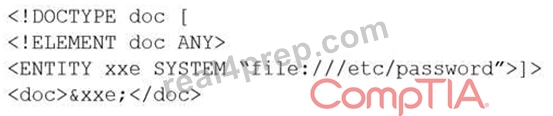
Which of the following would BEST mitigate this vulnerability?
- A. Data encoding
- B. Input validation
- C. CAPTCHA
- D. Network intrusion prevention
Answer: B
Explanation:
Reference: https://hdivsecurity.com/owasp-xml-external-entities-xxe
NEW QUESTION # 277
Ransomware encrypted the entire human resources fileshare for a large financial institution. Security operations personnel were unaware of the activity until it was too late to stop it. The restoration will take approximately four hours, and the last backup occurred 48 hours ago. The management team has indicated that the RPO for a disaster recovery event for this data classification is 24 hours.
Based on RPO requirements, which of the following recommendations should the management team make?
- A. Leave the current backup schedule intact and make the human resources fileshare read-only.
- B. Leave the current backup schedule intact and pay the ransom to decrypt the data.
- C. Increase the frequency of backups and create SIEM alerts for IOCs.
- D. Decrease the frequency of backups and pay the ransom to decrypt the data.
Answer: C
Explanation:
Increasing the frequency of backups and creating SIEM (security information and event management) alerts for IOCs (indicators of compromise) are the best recommendations that the management team can make based on RPO (recovery point objective) requirements. RPO is a metric that defines the maximum acceptable amount of data loss that can occur during a disaster recovery event. Increasing the frequency of backups can reduce the amount of data loss that can occur, as it can create more recent copies or snapshots of the data.
Creating SIEM alerts for IOCs can help detect and respond to ransomware attacks, as it can collect, correlate, and analyze security events and data from various sources and generate alerts based on predefined rules or thresholds. Leaving the current backup schedule intact and paying the ransom to decrypt the data are not good recommendations, as they could result in more data loss than the RPO allows, as well as encourage more ransomware attacks or expose the company to legal or ethical issues. Leaving the current backup schedule intact and making the human resources fileshare read-only are not good recommendations, as they could result in more data loss than the RPO allows, as well as affect the normal operations or functionality of the fileshare.
Decreasing the frequency of backups and paying the ransom to decrypt the data are not good recommendations, as they could result in more data loss than the RPO allows, as well as increase the risk of losing data due to less frequent backups or unreliable decryption. Verified References:
https://www.comptia.org/blog/what-is-rpohttps://partners.comptia.org/docs/default-source/resources/casp-conten
NEW QUESTION # 278
An ASIC manufacturer wishing to best reduce downstream supply chain risk can provide validation instructions for consumers that:
- A. Incorporate MD5 hashes of the ASIC design file.
- B. Leverage physically uncloneable functions.
- C. Include schematics traceable via X-ray interrogation.
- D. Analyze an emplaced holographic icon on the board.
Answer: B
Explanation:
Physically uncloneable functions (PUFs) are hardware-based features that leverage intrinsic physical properties of chips to create unique, non-reproducible identifiers. This reduces supply chain risks by enabling robust authentication and counterfeit prevention. This method aligns with CASP+ objective 4.3, which focuses on secure hardware design and supply chain risk management, ensuring authenticity and integrity of hardware components.
________________________________________
NEW QUESTION # 279
A security engineer is performing a threat modeling procedure against a machine learning system that correlates analytic information for decision support. Which of the following threat statements most likely applies to this type of system?
- A. An attacker accesses information that should not be disclosed due to an authorization error.
- B. An attacker is able to overload the system with incorrect information.
- C. An attacker exploits a server-side request forgery attack.
- D. An attacker conducts a password-spraying attack against the system's authentication method.
Answer: B
Explanation:
Overloading a machine learning system with incorrect information is an example of poisoning the data set, which can compromise the integrity of decision-making processes. This aligns with CASP+ objective 2.3, which involves threat modeling and mitigating risks associated with AI and ML systems.
NEW QUESTION # 280
A security administrator at a global organization wants to update password complexity rules for a system containing personally identifiable information. Which of the following would be the best resource for this information?
- A. NIST
- B. COPPA
- C. CMMI
- D. GDPR
Answer: A
Explanation:
Step by Step Explanation:
* NIST (National Institute of Standards and Technology): Provides comprehensive password guidelines (e.g., SP 800-63B) widely used for securing systems, including handling PII.
* GDPR (General Data Protection Regulation): Focuses on data privacy laws rather than technical password policies.
* CMMI (Capability Maturity Model Integration): Addresses process improvement, not password complexity.
* COPPA (Children's Online Privacy Protection Act): Focuses on child data privacy, not password rules.
Reference: CASP+ Exam Objectives 5.3 - Implement security controls and best practices using NIST standards.
NEW QUESTION # 281
A security analyst is investigating a series of suspicious emails by employees to the security team. The email appear to come from a current business partner and do not contain images or URLs. No images or URLs were stripped from the message by the security tools the company uses instead, the emails only include the following in plain text.
Test email sent from bp_app01 to external client_app01_mailing_list.
Which of the following should the security analyst perform?
- A. Block the IP address for the business partner at the perimeter firewall.
- B. Contact the security department at the business partner and alert them to the email event.
- C. Pull the devices of the affected employees from the network in case they are infected with a zero- day virus.
- D. Configure the email gateway to automatically quarantine all messages originating from the business partner.
Answer: B
NEW QUESTION # 282
A security operations center analyst is investigating anomalous activity between a database server and an unknown external IP address and gathered the following data:
* dbadmin last logged in at 7:30 a.m. and logged out at 8:05 a.m.
* A persistent TCP/6667 connection to the external address was established at 7:55 a.m. The connection is still active.
* Other than bytes transferred to keep the connection alive, only a few kilobytes of data transfer every hour since the start of the connection.
* A sample outbound request payload from PCAP showed the ASCII content: "JOIN #community".
Which of the following is the MOST likely root cause?
- A. A botnet Trojan is installed on the database server.
- B. The system has been hijacked for cryptocurrency mining.
- C. A SQL injection was used to exfiltrate data from the database server.
- D. The dbadmin user is consulting the community for help via Internet Relay Chat.
Answer: D
Explanation:
The dbadmin user is consulting the community for help via Internet Relay Chat. The clues in the given information point to the dbadmin user having established an Internet Relay Chat (IRC) connection to an external address at 7:55 a.m. This connection is still active, and only a few kilobytes of data have been transferred since the start of the connection. The sample outbound request payload of "JOIN #community" also suggests that the user is trying to join an IRC chatroom. This suggests that the dbadmin user is using the IRC connection to consult the community for help with a problem. Therefore, the root cause of the anomalous activity is likely the dbadmin user consulting the community for help via IRC. References: CompTIA Advanced Security Practitioner (CASP+) Study Guide, Chapter 10, Investigating Intrusions and Suspicious Activity.
NEW QUESTION # 283
SIMULATION
A product development team has submitted code snippets for review prior to release.
INSTRUCTIONS
Analyze the code snippets, and then select one vulnerability, and one fix for each code snippet.
Code Snippet 1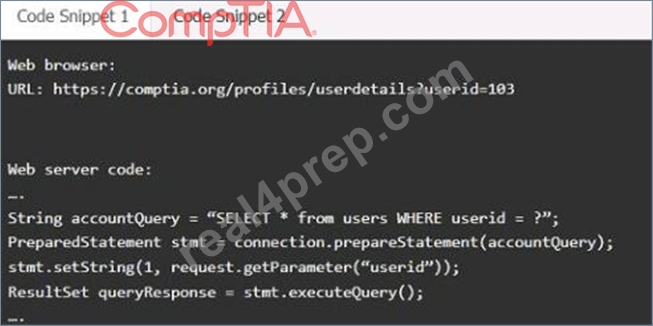
Code Snippet 2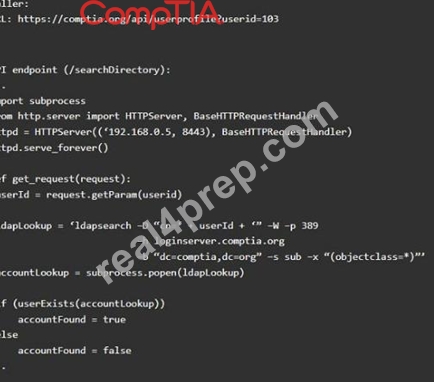
Vulnerability 1:
SQL injection
Cross-site request forgery
Server-side request forgery
Indirect object reference
Cross-site scripting
Fix 1:
Perform input sanitization of the userid field.
Perform output encoding of queryResponse,
Ensure usex:ia belongs to logged-in user.
Inspect URLS and disallow arbitrary requests.
Implement anti-forgery tokens.
Vulnerability 2
1) Denial of service
2) Command injection
3) SQL injection
4) Authorization bypass
5) Credentials passed via GET
Fix 2
A) Implement prepared statements and bind
variables.
B) Remove the serve_forever instruction.
C) Prevent the "authenticated" value from being overridden by a GET parameter.
D) HTTP POST should be used for sensitive parameters.
E) Perform input sanitization of the userid field.
Answer:
Explanation:
See the solution below in explanation
Explanation:
Code Snippet 1
Vulnerability 1: SQL injection
SQL injection is a type of attack that exploits a vulnerability in the code that interacts with a database. An attacker can inject malicious SQL commands into the input fields, such as username or password, and execute them on the database server. This can result in data theft, data corruption, or unauthorized access.
Fix 1: Perform input sanitization of the userid field.
Input sanitization is a technique that prevents SQL injection by validating and filtering the user input values before passing them to the database. The input sanitization should remove any special characters, such as quotes, semicolons, or dashes, that can alter the intended SQL query. Alternatively, the input sanitization can use a whitelist of allowed values and reject any other values.
Code Snippet 2
Vulnerability 2: Cross-site request forgery
Cross-site request forgery (CSRF) is a type of attack that exploits a vulnerability in the code that handles web requests. An attacker can trick a user into sending a malicious web request to a server that performs an action on behalf of the user, such as changing their password, transferring funds, or deleting dat a. This can result in unauthorized actions, data loss, or account compromise.
Fix 2: Implement anti-forgery tokens.
Anti-forgery tokens are techniques that prevent CSRF by adding a unique and secret value to each web request that is generated by the server and verified by the server before performing the action. The anti-forgery token should be different for each user and each session, and should not be predictable or reusable by an attacker. This way, only legitimate web requests from the user's browser can be accepted by the server.
NEW QUESTION # 284
A company's Chief Information Security Officer is concerned that the company's proposed move to the cloud could lead to a lack of visibility into network traffic flow logs within the VPC.
Which of the following compensating controls would be BEST to implement in this situation?
- A. SIEM
- B. HIDS
- C. UEBA
- D. EDR
Answer: A
Explanation:
Security information and event management (SIEM) solutions provide near realtime analysis of security alerts generated by a wide variety of network hardware, systems, and applications. SIEM platforms enhance incident detection and response capabilities by providing expanded insights into operational activity through collection, aggregation, and correlation of vast volumes of event data across the entire enterprise environmentSIEM removes much of the need to analyze individual systems by collecting log data and parsing it in a way that makes it easily searched and analyzed regardless of the underlying log format. Additionally, SIEM platforms remove much of the specialized knowledge needed to locate and analyze logs collected and stored on individual systems. For example, a security analyst can learn how to search and query for events using SIEM methods instead of learning how to interact with multiple operating systems, network devices, and/or applications to perform the same task.
NEW QUESTION # 285
A company is implementing SSL inspection. During the next six months, multiple web applications that will be separated out with subdomains will be deployed.
Which of the following will allow the inspection of the data without multiple certificate deployments?
- A. Include all available cipher suites.
- B. Create a wildcard certificate.
- C. Implement certificate pinning.
- D. Use a third-party CA.
Answer: C
NEW QUESTION # 286
A software developer needs to add an authentication method to a web application. The following requirements must be met:
* The web application needs to use well-supported standards.
* The initial login to the web application should rely on an outside, trusted third party.
* The login needs to be maintained for up to six months.
Which of the following would best support these requirements? (Select two).
- A. SAML
- B. RADIUS
- C. Kerberos
- D. Remote attestation
- E. EAP
- F. JWT
Answer: A,F
Explanation:
To meet the requirements for authentication using trusted third parties and session maintenance, SAML (Security Assertion Markup Language) and JWT (JSON Web Token) are the best options. SAML is widely used for single sign-on (SSO) and federated authentication, allowing users to authenticate with an external identity provider (trusted third party). JWT is commonly used for maintaining authenticated sessions across web applications and is well-suited for long-term session management, like the six-month duration mentioned. Together, these solutions meet the requirements for standards-based authentication and long- lasting sessions. CASP+ discusses the role of SAML in federated identity management and JWT in token- based authentication.
References:
CASP+ CAS-004 Exam Objectives: Domain 2.0 - Enterprise Security Operations (Federated Identity Management, JWT, SAML) CompTIA CASP+ Study Guide: Web Application Authentication with SAML and JWT
NEW QUESTION # 287
A company has decided that only administrators are permitted to use PowerShell on their Windows computers. Which of the following is the BEST way for an administrator to implement this decision?
- A. Provide user education and training.
- B. Configure user settings in Group Policy.
- C. Block PowerSheII via HIDS.
- D. Uninstall PowerSheII from all workstations.
- E. Monitor the Application and Services Logs group within Windows Event Log.
Answer: B
Explanation:
Configuring user settings in Group Policy is the best way for an administrator to implement the decision to restrict PowerShell access to only administrators. Group Policy is a feature of Windows that allows administrators to manage and enforce settings for users and computers in a domain. By using Group Policy, an administrator can create a policy that blocks or disables PowerShell for all users except for a particular group, such as administrators. This policy can be applied to all computers in the domain or to specific organizational units. This method is more effective and manageable than uninstalling PowerShell, monitoring event logs, providing user education, or blocking PowerShell via HIDS. Verified Reference:
https://www.windowscentral.com/how-disable-powershell-windows-10
https://learn.microsoft.com/en-us/answers/questions/195218/how-to-restrict-powershell-for-all-users-except-fo
https://windowsloop.com/block-disable-powershell/
NEW QUESTION # 288
A security analyst is concerned that a malicious piece of code was downloaded on a Linux system. After some research, the analyst determines that the suspected piece of code is performing a lot of input/output (I/O) on the disk drive.
Based on the output above, from which of the following process IDs can the analyst begin an investigation?
- A. 0
- B. 1
- C. 2
- D. 3
Answer: D
NEW QUESTION # 289
Given the following information:
* Firewall rules: Existing rules do not account for Web Server C's IP address (10.2.0.92).
* Application A Security Group: Inbound rules and outbound rules are insufficient for the new server.
The security team wants to minimize the firewall rule set by avoiding specific host rules whenever possible.
Which of the following actions must be taken to resolve the issue and meet the security team's requirements?
- A. Change the security group inbound rules to include the new IP address of Web Server C
- B. Reconfigure Web Server C to 10.2.0.62
- C. Alter the security group outbound rules to be more restrictive
- D. Modify the firewall rules to include the new IP address of Web Server C
Answer: D
Explanation:
Comprehensive and Detailed Step by Step Explanation:
* The issue stems from Web Server C's new IP (10.2.0.92) not being included in the firewall rules.
* To resolve the issue, modify the firewall rules to include the new IP range (e.g., 10.2.0.0/26) rather than adding a specific host rule, ensuring scalability and simplicity.
* Changing inbound or outbound security group rules would still miss the underlying issue of omitted IPs.
* Reconfiguring the IP is unnecessary when updating firewall rules is sufficient.
References:
* CompTIA CASP+ Exam Objective 2.2: Implement network security solutions.
* CASP+ Study Guide, 5th Edition, Chapter 7, Network Security.
NEW QUESTION # 290
......
CAS-004 Exam Dumps - PDF Questions and Testing Engine: https://lead2pass.real4prep.com/CAS-004-exam.html