


Excellent UiPath-ADPv1 Updated 2026 Dumps With 100% Exam Passing Guarantee
Best way to practice test for UiPath UiPath-ADPv1
UiPath UiPath-ADPv1 Exam Syllabus Topics:
| Topic | Details |
|---|---|
| Topic 1 |
|
| Topic 2 |
|
| Topic 3 |
|
| Topic 4 |
|
NEW QUESTION # 104
A developer configured the properties for a Click activity on an element inside a web page as shown in the following exhibit.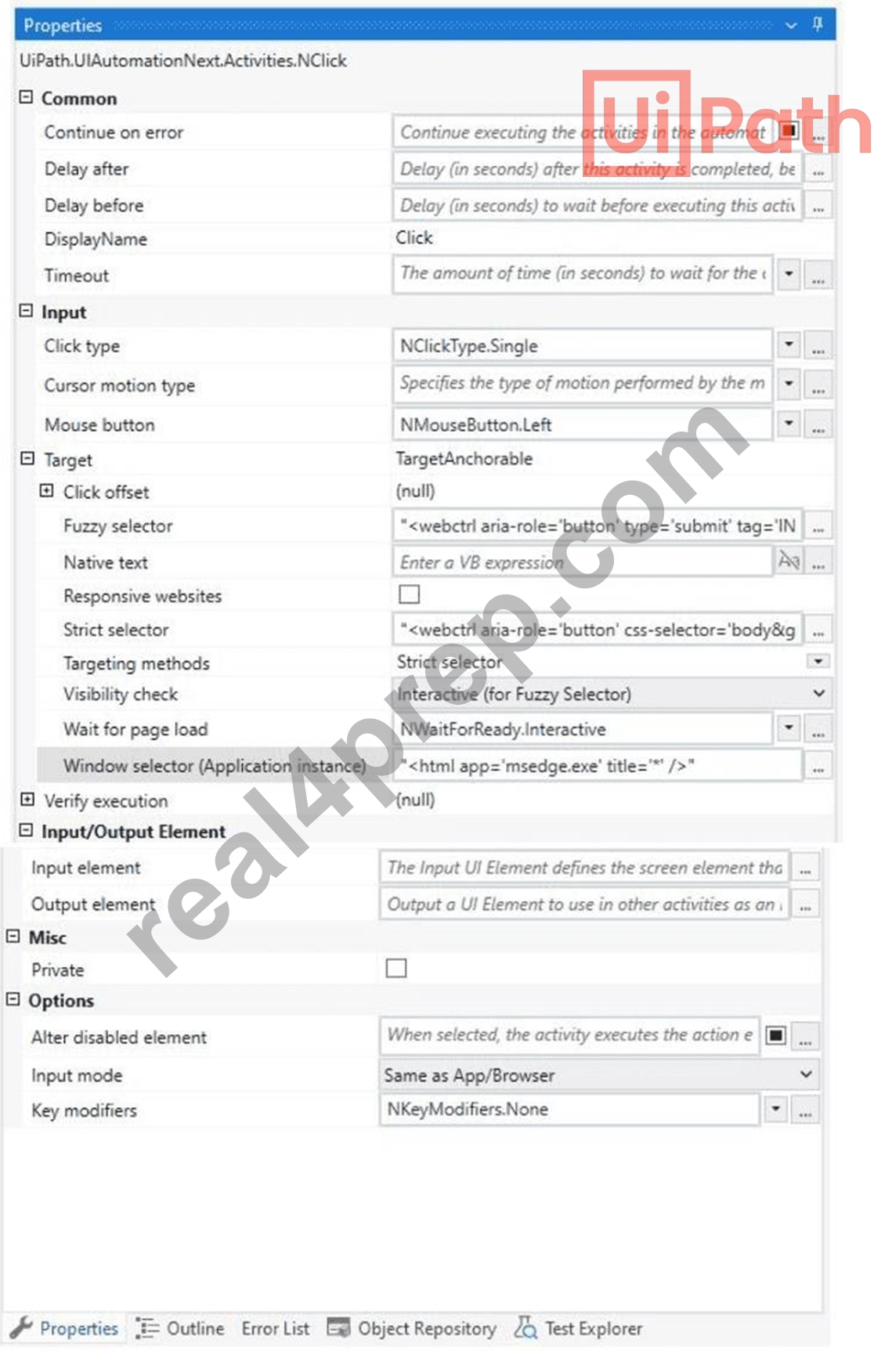
An animation on the web page never completely loads but the element indicated in the Click activity does load within the specified timeout duration. What occurs when this Click activity executes?
- A. Element is clicked once the element is fully loaded.
- B. Waits 10 seconds before clicking on the element.
- C. Timeout error occurs without clicking on the element.
- D. Continues to the next activity after 30 seconds without clicking on the element.
Answer: A
Explanation:
Click activity has the following properties:
*ClickType: Single
*MouseButton: Left
*Target.Timeout: 30000 ms (30 seconds)
*Target.WaitForReady: Interactive
The Target.Timeout property specifies the amount of time (in milliseconds) to wait for the activity to run before the SelectorNotFoundException error is thrown1. The default value is 30000 milliseconds (30 seconds)
2.
The Target.WaitForReady property determines how long the activity should wait for the target UI element to be ready before performing the action1. The following options are available:
*None: Does not wait for anything except the target UI element to exist before executing the action1.
*Interactive: Waits until only a part of the app is loaded1.
*Complete: Waits for the entire app to be loaded1.
The default value is Interactive2, which means that the activity will wait until the UI element is visible and can be interacted with3.
Therefore, based on these properties, the Click activity will wait for the element indicated by the selector to be loaded and clickable within 30 seconds. If the element is loaded before the timeout, the activity will click it and continue to the next activity. If the element is not loaded within the timeout, the activity will throw an error and stop the execution. The animation on the web page does not affect the Click activity, as long as the target element is loaded and visible. Hence, the correct answer is A. Element is clicked once the element is fully loaded.
NEW QUESTION # 105
Considering that the attached table is stored in a variable called "dt":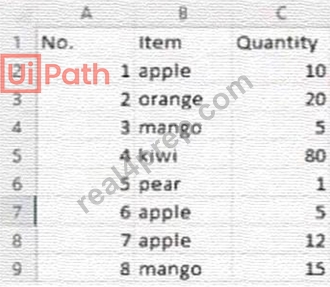
Which LINQ query can be used to return the maximum total Quantity?
- A. dt.AsEnumerable. GroupBy(Function(x) x("Item").ToString). Max(Function(x) x.Sum(Function(y) Convert.ToInt32(y("Quantity").ToString)))
- B. dt.AsEnumerable. Max(Function(x) Convert.ToInt32(x("Quantity").ToString))
- C. dt.AsEnumerable. Max(Function(x) Convert.ToInt32(x("Quantity").ToString))("Item")
- D. dt.AsEnumerable. OrderByDescending(Function(x) Convert.ToInt32(x("Quantity").ToString)).First.Item("Quantity")
Answer: A
Explanation:
The LINQ query that can be used to return the maximum total Quantity from the attached table is dt.AsEnumerable. GroupBy(Function(x) x("Item").ToString). Max(Function(x) x.Sum(Function(y) Convert.ToInt32(y("Quantity").ToString))). This query uses the LINQ methods AsEnumerable, GroupBy, Max, and Sum to manipulate the data in the dt variable. The dt variable is a DataTable that contains the following data:
No.
Item
Quantity
1
apple
10
2
orange
20
3
mango
50
4
kiwi
80
5
pear
1
6
apple
5
7
mango
15
The AsEnumerable method converts the DataTable into an Enumerable collection of DataRow objects. The GroupBy method groups the elements of the collection by the value of the Item column, creating a collection of groups. Each group has a key, which is the Item name, and a list of elements, which are the DataRows that have the same Item value. The Max method returns the maximum value of the collection, based on a selector function. The selector function is a lambda expression that calculates the sum of the Quantity column for each group. The Sum method returns the sum of the elements in a collection, based on a selector function. The selector function is a lambda expression that converts the value of the Quantity column into an integer.
Therefore, the query will group the DataRows by the Item name, calculate the total Quantity for each group, and return the maximum total Quantity among the groups. The maximum total Quantity is 80, which corresponds to the group with the key "kiwi". References: [DataTable.AsEnumerable Method],
[Enumerable.GroupBy Method], [Enumerable.Max Method], [Enumerable.Sum Method]
NEW QUESTION # 106
Where is the TransactionNumber incremented in the REFramework?
- A. Only in the SetTransactionStatus.xaml workflow.
- B. Only in the RetryCurrentTransaction.xaml workflow.
- C. In the New Transaction transition.
- D. In the RetryCurrentTransaction.xaml workflow and in the SetTransactionStatus.xaml workflow.
Answer: A
Explanation:
The TransactionNumber is incremented only in the SetTransactionStatus.xaml workflow, which is invoked at the end of each transaction. This workflow updates the status of the current transaction item in Orchestrator and increments the TransactionNumber by one. The TransactionNumber is used to keep track of the number of transactions processed by the robot and to get the next transaction item from the queue. References:
[SetTransactionStatus.xaml]
NEW QUESTION # 107
Based on the following exhibit, which output is displayed in the Output panel rt Step Out is clicked on the Debug ribbon tab of UlPath Studio?
- A. Automation
- B. UiPath RPAAutomatlon
- C. Automation RPAUiPath RPA
- D. UiPath RPA
Answer: B
NEW QUESTION # 108
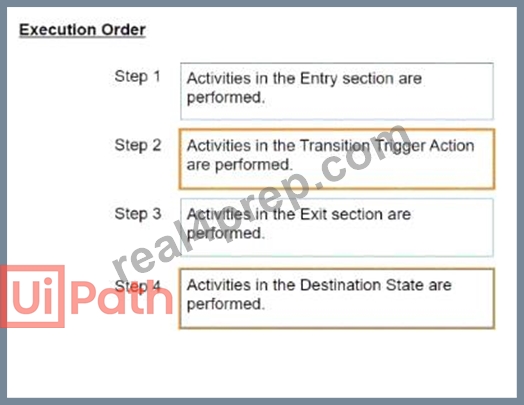
What is the correct execution order of the State activity sections?
instructions: Drag the Description found on the "Left" and drop on the correct Execution Order found on the
"Right"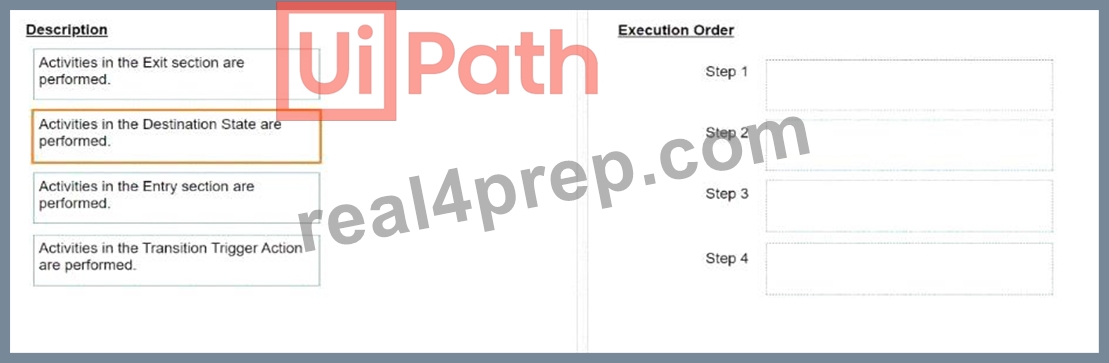
Answer:
Explanation:
NEW QUESTION # 109
What do the percentages from the Test Explorer panel represent?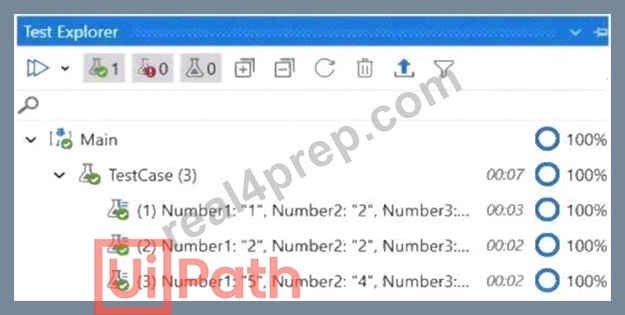
- A. Passing percent.
- B. Percent of test data run.
- C. Coverage percent.
- D. Correctness of the code percent.
Answer: A
Explanation:
The percentages from the Test Explorer panel represent the passing percent of the test cases that are executed.
The Test Explorer panel shows the status of each test case, the total number of test cases, the number of passed test cases, the number of failed test cases, and the passing percent. The passing percent is calculated by dividing the number of passed test cases by the total number of test cases and multiplying by 100. For example, if there are 10 test cases and 8 of them pass, the passing percent is 80%. References: Test Explorer
NEW QUESTION # 110
While working in an RPA testing project, you encountered the following activity in one of the workflows included in the project.
What action can you perform in your mocked file to replace the functionality of the MessageBox with a LogMessage during mock testing?
- A. Create mock workflow.
- B. Remove mock activity.
- C. Synchronize mock.
- D. Surround activity with mock.
Answer: D
Explanation:
To replace the functionality of the MessageBox with a LogMessage during mock testing, the developer can perform the action of Surround activity with mock. This action inserts a mock activity around the selected activity, which allows the developer to change the behavior of the activity for testing purposes. For example, the developer can right-click on the MessageBox activity and select Surround activity with mock from the dropdown menu. This will create a mock activity that contains the MessageBox activity. The developer can then edit the mock activity and replace the MessageBox activity with a LogMessage activity, which will write the message to the output panel instead of displaying it in a dialog box. This way, the developer can test the functionality of the workflow without having to interact with the MessageBox dialog box. References: [Mock Testing], [Surround Activity with Mock]
NEW QUESTION # 111
The following table is stored in a variable called "dt".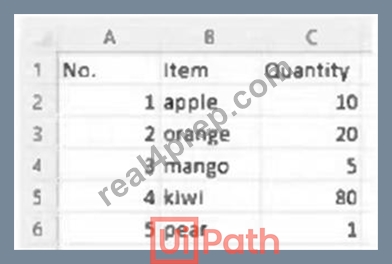
What will the value of the qty variable be after executing the Assign activity?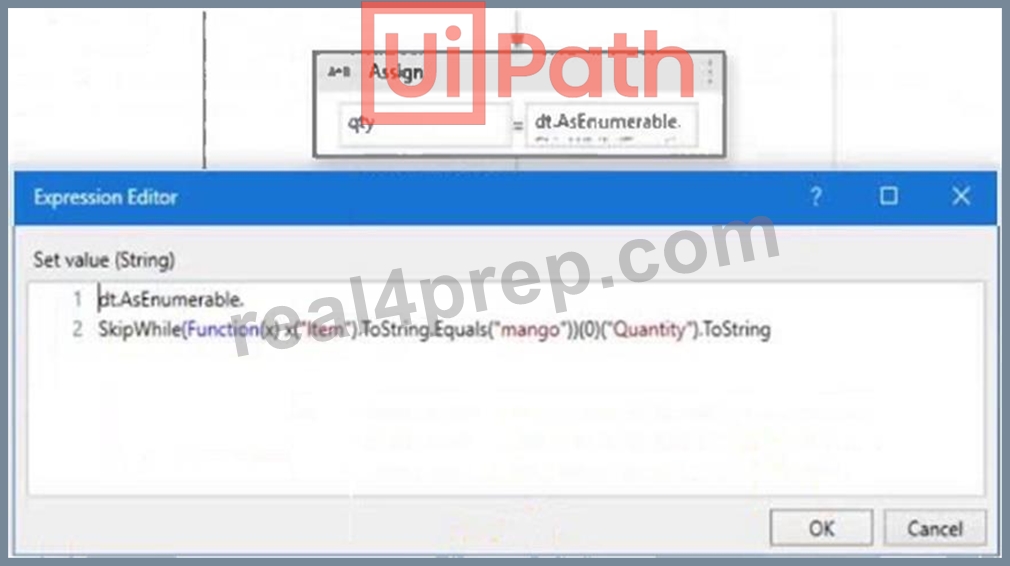
- A. 0
- B. 1
- C. null
- D. 2
Answer: B
NEW QUESTION # 112
While working in an RPA testing project, you encountered the following activity in one of the workflows included in the project.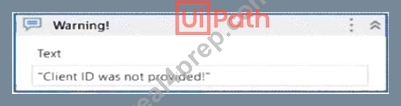
What action can you perform in your mocked file to replace the functionality of the MessageBox with a LogMessage during mock testing?
- A. Create mock workflow.
- B. Remove mock activity.
- C. Synchronize mock.
- D. Surround activity with mock.
Answer: D
Explanation:
To replace the functionality of the MessageBox with a LogMessage during mock testing, the developer can perform the action of Surround activity with mock. This action inserts a mock activity around the selected activity, which allows the developer to change the behavior of the activity for testing purposes. For example, the developer can right-click on the MessageBox activity and select Surround activity with mock from the dropdown menu. This will create a mock activity that contains the MessageBox activity. The developer can then edit the mock activity and replace the MessageBox activity with a LogMessage activity, which will write the message to the output panel instead of displaying it in a dialog box. This way, the developer can test the functionality of the workflow without having to interact with the MessageBox dialog box. References: [Mock Testing], [Surround Activity with Mock]
NEW QUESTION # 113
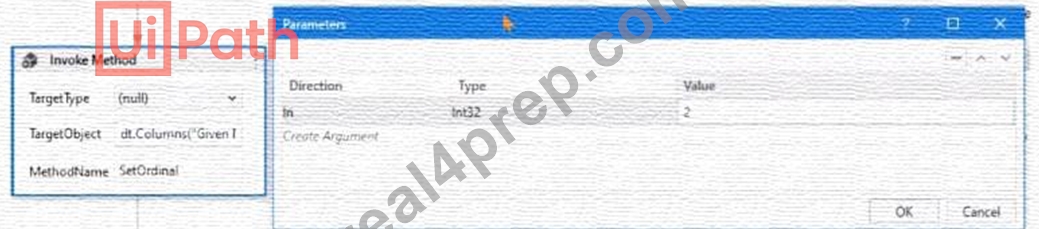
Given a dataiable "dt" with the following header:
"Surname. Address. Zip Code, Given Name, Phone Number.
What is the correct configuration of the Invoke Method activity so that the resulting header will be:
"Surname. Given Name. Address. Zip Code. Phone Number".
- A.

- B.
- C.

- D.

Answer: A
NEW QUESTION # 114
Given the following conditional breakpoint with count = 0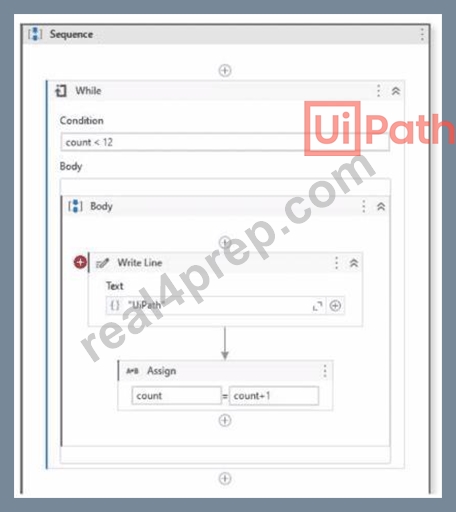
Conditional breakpoint settings:
How many limes will UiPath be displayed in the Output panel before the process goes into a Paused state in Debug mode?
- A. 0
- B. 1
- C. 2
- D. 3
Answer: A
NEW QUESTION # 115
How would you define a linear process in UiPath?
- A. The steps of the process repeat multiple times over different data items. However, the automation design is such that each repeatable part processes independently.
- B. The steps of the process refer to the execution of steps in a sequential manner, where each subsequent step depends on the successful completion of the previous step.
- C. The steps of the process are performed multiple times, but each time different data items are used.
- D. The process steps are performed only once. If the need is to process additional data, then the automation must execute again.
Answer: D
Explanation:
A linear process in UiPath is a type of process that is executed only once and does not involve any looping or branching logic. It is suitable for simple scenarios where the input data is fixed and the output is predictable.
A linear process can be designed using a Sequence or a Flowchart diagram, but it does not use any Flow Decision, Switch, While, Do While, or For Each activity. If the process needs to process additional data, then the automation must be executed again with the new data as input. References: Framework for linear process or single transaction, How to modify ReFramework to Linear Process, Workflow Design, Difference between Linear process and Transactional process
NEW QUESTION # 116
A developer is using a Type into activity with the Input Method set to Simulate Which property needs to Be enabled for the activity to execute even it the target Ul element is deactivated or read-only?
- A. Alter disabled element.
- B. Deselect at end.
- C. Click before typing.
- D. Activate.
Answer: A
Explanation:
When using the Type Into activity with the Input Method set to Simulate, the 'Alter disabled element' property should be enabled to execute the activity even if the target UI element is deactivated or read-only.
NEW QUESTION # 117
In the Robotic Enterprise (RE) Framework, at which point should a developer log a clear message with the Logging Level set to "Information," adhering to the best practices for automating a production-level process?
- A. Whenever the robot encounters an error on a Queue Item.
- B. Whenever an argument or value is used.
- C. Whenever data is fetched from external sources.
- D. Whenever an exception is caught in a Catch block.
Answer: D
Explanation:
The point at which a developer should log a clear message with the Logging Level set to "Information", adhering to the best practices for automating a production-level process, is whenever data is fetched from external sources. Logging is the process of recording and storing information about the execution and status of a workflow. Logging is essential for debugging, monitoring, and auditing purposes. The Logging Level is a property that determines the level of detail and severity of the information that is logged. The Logging Level can be set to Trace, Verbose, Information, Warning, Error, or Fatal. The Information level is used to log general information about the workflow, such as the start and end of a process, the name and value of a variable, or the result of an operation. The best practice for logging with the Information level is to log whenever data is fetched from external sources, such as databases, web services, or files. This can help the developer to verify the accuracy and completeness of the data, as well as to track the source and destination of the data. Logging whenever data is fetched from external sources can also help the developer to identify any issues or errors that might occur during the data retrieval or processing. References: [Logging Levels],
[Logging Best Practices]
NEW QUESTION # 118
When configuring the Max # of retries for the queue in Orchestrator to "1" for your process, and the queue has 5 transaction items. At runtime, the first transaction item throws a Business Rule Exception.
How does the process proceed?
- A. Transaction is retried only one time.
- B. Transaction is not retried and the process stops.
- C. Transaction is not retried but remaining transactions continue processing.
- D. Transaction is retried multiple times until processed successfully.
Answer: C
Explanation:
A Business Rule Exception is a type of exception that indicates that the data or the input required for the automation process is incomplete or invalid1. For example, a Business Rule Exception can occur when a phone number is missing a digit, or when a mandatory field is left blank1. A Business Rule Exception is usually thrown by the developer using the Throw activity, and it is handled by the Set Transaction Status activity, which sets the status of the transaction item to Failed and adds the exception details to the queue item2. By default, Orchestrator does not retry transactions that are failed due to Business Rule Exceptions, regardless of the Max # of retries setting for the queue3. This is because retrying the transaction does not solve the issue, and there are other better courses of action, such as notifying the human user of the error1.
Therefore, if the first transaction item throws a Business Rule Exception, the transaction is not retried, but the remaining transactions continue processing, as long as they do not encounter any other exceptions.
NEW QUESTION # 119
What is the recommended approach for handling tabular data when building a REFramework transactional project in UiPath?
- A. Utilize a DataTable variable to store and process the tabular data.
- B. Save the tabular data in multiple CSV files for easier manipulation.
- C. Use separate variables to store each column of the tabular data.
Answer: A
Explanation:
D Implement custom activities to handle the tabular data
NEW QUESTION # 120
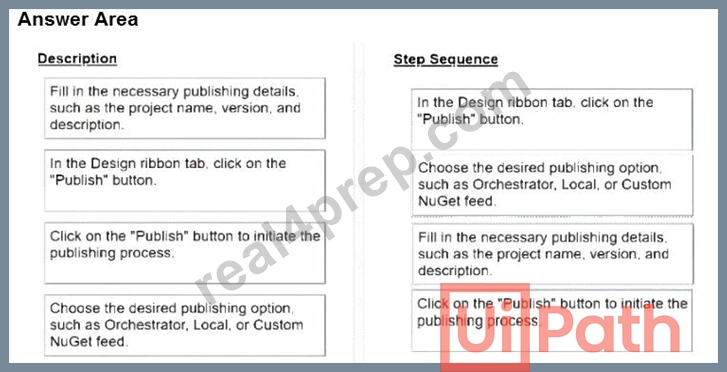
What are the steps to publish a project from UiPath Studio?
Instructions: Drag the Description found on the "Left" and drop on the correct Step Sequence found on the
"Right".
Answer:
Explanation:
NEW QUESTION # 121
......
UiPath (ADPv1) Automation Developer Professional Certification Sample Questions and Practice Exam: https://lead2pass.real4prep.com/UiPath-ADPv1-exam.html