


Download Qlik QSDA2022 Mock Test Study Material
QSDA2022 Questions Prepare with Learning Information
Qlik QSDA2022 is a certification exam for individuals who want to become certified Qlik Sense Data Architects. The exam is designed to test your knowledge of data architecture concepts and your ability to design and implement data models using Qlik Sense.
Qlik QSDA2022 is the latest certification exam for Qlik Sense Data Architect. This exam is designed to test the knowledge and skills of data architects who work with Qlik Sense. The exam covers a wide range of topics related to data architecture, including data modeling, data integration, data transformation, and data governance. Passing this certification exam demonstrates a strong understanding of Qlik Sense data architecture and the ability to design and implement scalable data solutions.
NEW QUESTION # 11
A customer has a dataset that contains latitude and longitude data for service points around the country. The data is retrieved using the following statement:
It must be clear to the end user that this is geographic data. Drag and drop, map-based visualization of this data is required. Which two steps should the data architect take to support this data? (Select two.)
- A. Define Location as a master item, and set the tag to Sgeodata
- B. Add the following to the end of the script:
TAG FIELD LocationName With 'Sgeoname', *@relates_Pt';
TAG FIELD Point With 'Sgeopoint*f 'Srelates Location', '$hidden'; - C. Add the following to the end of the script:
TAG FIELD LocationName With 'Sgeodata1, 'Srelated'; TAG FIELD Point With 'Sgeodata', 'Srelated1; - D. Add GeoKakePoint (Lat, Long} as Point to Location's preceding load
- E. Add GeoProject{' Point' , Lat&Long) AS Point to the preceding load
Answer: B,E
NEW QUESTION # 12
A data architect needs to create an app to analyze 30-day re-admissions at a hospital.
* The medical record system does NOT calculate re-admission data
* The business rule to follow: if a patient is admitted to a hospital within 30 days after being discharged from a previous hospital stay, that event should be captured in the app with a flag called "30-day Re-admission"
* Data being used from the patient record includes hospital account ID, patient ID, admission dater and discharge date Which action should the data architect perform first to meet these requirements?
- A. Sequence patient records by patient ID using the Peek function
- B. Sequence patient records by hospital account ID and patient ID using the Peek function
- C. Order patient records by patient ID and admission date
- D. Calculate the days since previous discharge using admission date and discharge date
Answer: C
NEW QUESTION # 13
The Marketing department is using some similar KPIs in different apps that need to be modified frequently according to the business needs. The KPIs are created using master items with the same expression.
Which method should the data architect use to manage the modifications in all apps?
- A. Create only a single app with allthe master items needed and protect it with SECTION ACCESS.
- B. Create a selection app with all the master items and use an on-demand app generation method.
- C. Create a core app with all the master items needed and use a BINARY load in the other apps.
- D. Create a variable repository and load them using INCLUDE statements in the apps where needed
Answer: D
Explanation:
Explanation
This method allows the data architect to store the KPIs in a single repository and then use INCLUDE statements to load them into the other apps. This makes it easy to modify the KPIs inone place and have the changes reflected in all the apps.Source: Qlik A variable repository is a centrallocation where all of the master items used in the apps can be stored and managed. By creating a variable repository and loading the master items into each app using INCLUDE statements, the data architect can make modifications to the master items in oneplace, and the changes will be automatically propagated to all of the apps that use the master items.
This method allows for easy management of the master items and eliminates the need to make changes to each app individually, which can be time-consuming and prone to errors.
NEW QUESTION # 14
A data architect builds a data model for a large user group. Some sheets will be published, and the app will allow users to create their own visualizations and analyze data. Some fields must NOT appear in any field list.
How should a data architect meet these requirements?
- A. Use security rules
- B. Use HidePrefix variable
- C. Use HideField variable
- D. Add fields to master items
Answer: A
Explanation:
Explanation
The best way for a data architect to meet the requirements of not allowing some fields to appear in any field list is to use security rules. Security rules can be used to restrict access to certain fields, which will ensure that they don't appear in any field list or visualization. Additionally, security rules can also be used to restrict access to certain data models, ensuring that only users with the right permissions can view and analyze the data.
Row-level security (RLS) with Power BI - Power BI | Microsoft Learn
https://learn.microsoft.com/en-us/power-bi/enterprise/service-admin-rls What Is Data Visualization? Definition & Examples | Tableau
https://www.tableau.com/learn/articles/data-visualization
80+ Top Power BI Interview Questions and Answers [Updated 2023]
https://www.edureka.co/blog/interview-questions/power-bi-interview-questions/
NEW QUESTION # 15
A data architect executes the following script:
Whatwill be the result of Table A?
A)
B)
C)
D)
- A. Option C
- B. Option A
- C. Option B
- D. Option D
Answer: D
NEW QUESTION # 16
Refer to the exhibit.
A data architect needs to add a Budget table to the current Qlik Sense app. A Budget table with the fields Budget, CustomerlD, and ProductlD is loaded into the model. What will be created?
- A. A synthetic table with three synthetic keys
- B. A synthetic table with two synthetic keys
- C. A circular reference with one table disconnected
- D. A synthetic table and one synthetic key
Answer: C
NEW QUESTION # 17
A company has a stream with multiple apps One of the apps is a multi-regional sales app.
A data architect must set up security for users to access the stream, enter the app, and view specific sheets and data.
Whichfeatures should the data architect use to meet these requirements?
- A. Section access and set analysis
- B. QMC security rules and custom properties
- C. QMC security rules and section access
- D. Section access and sheet properties
Answer: C
NEW QUESTION # 18
Refer to the exhibit.
A data architect is loading the tables and a synth key is generated.
How should the data architect resolve the synthetic key?
- A. Remove the LineNo field from both tables and use the AutoNumberfunction on the OrderlC field
- B. Create a composite key using OrdertD and LineNo
- C. Create a composite key using OrderlD and LineNo. and remove OrderlD and LineNo from Shipments
- D. Remove the LineNo field from Shipments and use the AutoNumber function on the
Answer: C
NEW QUESTION # 19
A data architect is using an Include statement to load the collection of variables from a TextFiles folder connection into an app. The data architect needs to load the data and generate an error if it fails.
Which statement should the data architect use?
- A. (Includs=lib://TextFiles/Variables.txt);
- B. (Must_Include=lib://TextFiies/Variables.txt);
- C. $<Include=lib://TextFiles/Variables.txt);
- D. $(Must_Include=lib://TextFiles/Variables.txt);
Answer: D
Explanation:
Explanation
The MustInclude statement provides an error if the include fails and is used when including files in Qlik Sense.
The other statements do not provide an error if the include fails.
qlik-sense-certification-exam-study-guide-en.pdf
https://www.qlik.com/us/-/media/files/training/global-us/qlik-sense-certification-exam-study-guide-en.pdf?la=en Talk to Experts Tuesday - Migrating from QlikView to Qlik Sense FAQ
https://community.qlik.com/t5/Support-Knowledge-Base/Talk-to-Experts-Tuesday-Migrating-from-QlikView-to Certifications & Qualifications | Qlik
https://www.qlik.com/us/services/training/certifications-and-qualifications The $(Must_Include) statement is used to load a file or a set of files and generate an error if the load fails. The
"Must_Include" function will stop the script execution if the file is not found or cannot be loaded. The correct syntax for using the "Must_Include" statement is $(Must_Include=lib://TextFiles/Variables.txt);
NEW QUESTION # 20 
A Human Resources Director needs an app to analyze organizational structure. The Directory is particularly interested in the longest levels of line management.
Two table loads are required. Both use the same basic structure.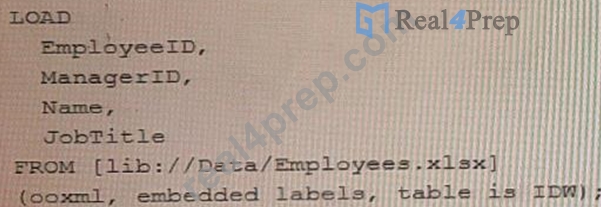
Which two table load prefixes are needed?
- A. * HierarchyBelongs.To(EmployeeID, ManagerlD, Name ManagerlD, Manager, Depth)
- B. *HierarchyLevel(EmployeelD, ManagerlD Name Level, '/', Structure)
*HierarchyBelongsTo(EmployeelD, ManagerlD, Name ManagerlD,Manager, Depth) - C. * HierarchyBelongsTo(ManagerlD, Manager, ManagerlD, ManagerlD, Manager Level)
* Hierarchy(EmployeelD, ManagerlD, Name. Manager Name, Structure '/' Depth) - D. * Hierarchy(EmployeelD. ManagerlD Name, Manager Name, Structure V,Depth)
* HierarchyLevelEmployeelD, ManagerlD, Name, Manager, Name, Structure, Depth '/')
Answer: A
NEW QUESTION # 21
Refer to the exhibit.
A business department is forecasting revenue within an Excel spreadsheet.
A data architect needs to include this forecast into the existing data model, and without losing any data.
Which two sets of steps will meet these requirements? (Select two.)
- A. 1. Load the Excel spreadsheet using the data load editor
2 Use the Crosstable function to unpivot the table
3 Create a composite key out of the date and region
4 Connect the new table to the data model - B. 1. Load the Excel spreadsheet using the data load editor
2. Use the Unpivot function
3 Use the Sum function to group the forecast by date
4 Connect to the existing data model - C. 1 Load the Excel spreadsheet into the data manager
2. Use the Unpivot function
3. Create a composite key from the date and region
4. Connect the new table to the data model
1 Load the Excel spreadsheet using the data manager
2 Rename the ForecastDate field to Date 3. Disable the Region
4 Connect to the existing data model - D. 1 Load the Excel spreadsheet using the data load editor
2. Change the sort order by date
3. Create a composite key out of the forecast and region 4 Connect to the existing data model
Answer: A,C
Explanation:
Explanation
Option B involves loading the Excel spreadsheet using the data load editor and then using the Crosstable function to unpivot the table, creating a composite key out of the date and region, and connecting the new table to the existing data model. Option D involves loading the Excel spreadsheet using the data manager, using the Unpivot function, creating a composite key from the date and region, and connecting the new table to the existing data model.
NEW QUESTION # 22 
Refer to the exhibits.
The first table, Mastersports, contains the master list of all sport names that need to be loaded into the app. The second table, TeamMembers, containsthe teams and team members registered for specific sports.
In a Qlik Sense app, a data architect is loading the two tables that need to be linked together based on the Sport field. The table format cannot be changed in the source.
What should the dataarchitect do in the data load editor?
- A. Apply a FOR loop to load to the MasterSports table creating the values for the Sport field
- B. Apply a preceding LOAD from the TeamMembers table with the SUBFIELD function and rename the field to Sport
- C. Apply a preceding LOAD to the MasterSports table with the SUBFIELD function to create the Sport field
Answer: A
NEW QUESTION # 23
A data architect needs to develop a script to export tables from a model based upon rules from an independent file. Thestructure of the text file with the export rules is as follows:
These rules govern which table in the model to export, what the target root filename should be, and the number of copies to export.
The TableToExport values are already verified to existin the model.
In addition, the format will always be QVD, and the copies will be incrementally numbered.
For example, the Customer table would be exported as:
What is the minimum set of scripting strategies the data architect must use?
- A. One loop and two IF statements
- B. One loop and one SELECT CASE statement
- C. Two loopswithout any conditional statement
- D. Two loops and one IF statement
Answer: B
Explanation:
Explanation
The data architect will need to use a single loop to iterate through the rows of the independent filecontaining the export rules. Within the loop, they will need to use a SELECT CASE statement to determine which table in the model to export based on the TableToExport value in the current row of the independent file. They can then use the StoreAsFilenamevalue to determine the target root filename, and the NumberOfCopies value to determine the number of copies to export.
This approach makes use of a single loop to iterate through the rows of the independent file, and a SELECT CASE statement to determine which table to export based on the TableToExport value in the current row. It is the most efficient way to accomplish the task with minimal scripting.
You can find the Qlik scripting documentation for Store statement
here:https://help.qlik.com/en-US/sense/June2020/Subsystems/Hub/Content/Scripting/ScriptPrefixes/Store.htman SELECT CASE statement here:https://help.qlik.com/en-US/sense/June2020/Subsystems/Hub/Content/Scripting/ScriptStatements/Select.htm
NEW QUESTION # 24
Refer to the exhibit.
USER1 has an app protected using this Section Access statement.
Which countries can USER1 see in the app''
- A. Italy, The Netherlands
- B. Italy, United Kingdom, The Netherlands
- C. Germany. Italy, United Kingdom, The Netherlands
- D. Germany Italy, The Netherlands
Answer: B
NEW QUESTION # 25
ITALY IT001 HR
GERMANY DE002 HR
SPAIN SP03 FINANCE
FRANCE FRO04 SALES
Refer to the exhibit
A company stores the employee data within a key composed of Country UserlD, and Department. These fields are separated by a blank space. The UserlD field iscomposed of two characters that indicate the country followed by a unique code of two or three digits. A data architect wants to retrieve only that unique code.
- A. LEFT(SUBFIELD(Key, ' ', 2), 2)
- B. LTRIM (SUBFIELD (Key, ' ', 2), 2)
- C. MID ( SUBFIELD (Key , ' ', 2), 3)
- D. RIGHT(SUBFIELD (Key,' ', 2), 3)
Answer: A
Explanation:
Explanation
This expression will extract the unique code from the key by using the SUBFIELD function to separate the key into its components, and then using the LEFT function to extract the first two characters of the second component.Source: Qlik
NEW QUESTION # 26
Multiple department fields in a dataset require a description
A data architect needs to add the department descriptions or a default value when the department does NOT have a description Which strategy should the data architect use to meet these requirements?
- A. ApplyMap with three parameters after the Mapping load
- B. Enter "Missing description" in the blank rows for Description xlsx then Mapping Load
- C. Left Join between tables and Description xlsx in every Department table
- D. ApplyMap with two parameters after the Mapping load
Answer: A
Explanation:
Explanation
This strategy involves using the ApplyMap function with threeparameters after the Mapping load. This will allow the data architect to add the department descriptions or a default value when the department does not have a description.Source: Qlik
NEW QUESTION # 27
Refer to the exhibit.
A data architect executes the script.
What will be the value of the first row for Field_1?
- A. Null
- B. D
- C. A
- D. 0
Answer: B
NEW QUESTION # 28
A global retailer has a large database in which millions of sales transactions are added per hour.
Each regional sales manager should only see details for customers in their region. After filtering based on criteria such as region, gender,and income level, sales managers should be able to see the most current detailed transactions.
What should a data architect do to meet these requirements?
- A. Use section access to restrict sales manager access by region
- B. Create an app for each sales manager with Qlik GeoAnalytics
- C. Use section access and include aservice account in the table
- D. Use On-Demand App Generation (ODAG) and section access
Answer: A
NEW QUESTION # 29
Users of a published app report incomplete visualizations. The data architect checks the app multiple timesand cannot replicate the error. The error affects only one team.
What is the most likely cause?
- A. The affected users were NOT added to the Section table
- B. Section access restricts too many records
- C. An Omit field has been applied
- D. A security rule has been applied to the sheet object
Answer: B
Explanation:
Explanation
Section access restricts access to certain records, and if too many records are restricted, it can lead to incomplete visualizations.Source: Qlik Section access is used to control access to the data in an app. If the section access settings are too restrictive, they can prevent certain users or teams from seeing all of the data they need, resulting in incomplete visualizations.
It is possible that the affected team has been assigned a section access that is too restrictive, preventing them from seeing all of the necessary data. This could be a misconfiguration or an oversight in the section access settings.
NEW QUESTION # 30 
Refer to the exhibit
A data architect is working on an app that contains orders, invoices, and shipping data. There are three different date fields within the data:
* OrderDate
* InvoiceDate
* ShippingDate
The business analyst needs to replicate the chart above to show Order and Shipping amounts on the same Month axis.
What should the data architect do?
- A. Create a Month field for each of the three dates in the fact table and use that in the chart
- B. Load the key field and the three date fields into a concatenated bridge table that contains KeyField and Date
- C. Left Join the three date fields onto one bridge table using the key field containing KeyField and Date
Answer: B
NEW QUESTION # 31
Refer to the exhibit.
A data architect is loading two tables into a data model from a SQL database These tables are related on key fields CustomerlD and CustomerKey.
Which script is valid to load the tables and maintain the correct association?
A)
B)
C)
D)
- A. Option D
- B. Option A
- C. Option C
- D. Option B
Answer: C
NEW QUESTION # 32
Refer to the exhibit.

Refer to the exhibits.
While using an app, the users report that some Sales Reps do NOT have personal details, like Division or Address Number A data architect has been called in to investigate.
The data architect uses the data model viewer to determine the relationship between the SalesRepMaster and CustomerMaster tables.
What is the cause of the issue?
- A. Density is 100% while Total Distinct and Present Distinct are NOT the same
- B. 59.3% of the Sales Rep have CustomerMaster information
- C. 26 values for Sales Rep are null in CustomerMaster
- D. 40.7% of the Sales Rep have CustomerMaster information
Answer: A
Explanation:
Explanation
When using the data model viewer to investigate the relationship between the SalesRepMaster and CustomerMaster tables, the data architect would look at the density of the relationship. Density is a measure of how well the key fields of a table match the key fields of another table. A density of 100% means that all key fields in one table have a match in the other table.
When the density is 100% but the total distinct and present distinct values for the key fields of the related tables do not match, it means that some of the key fields in one table do not have a match in the other table, this is the cause of the issue.
NEW QUESTION # 33
A company needs to analyze sales data based on the exchange rate of the different countries every day About
30 reports must be produced with an average of 20r000 rows each. This process is estimated to take about three hours.
Reports will be in Excel and distributed to business users according to defined security rules Which two products should the data architect use to build this solution? (Select two.)
- A. ODAG
- B. QIik NPrinting
- C. OQIikGeoAnalytics
- D. Qlik Storytelling
- E. QIikDataMarket
Answer: A,B
Explanation:
Explanation
The best answer choices are B.
ODAG and E. QIik NPrinting.
ODAG (On Demand Application Generation) is a product from Qlik that can be used to quickly generate reports from large datasets.
It can produce reports with up to 20,000 rows and can do so in less than three hours.
NPrinting is a product from Qlik that can be used to distribute the reports in Excel format according to the defined security rules.
NEW QUESTION # 34
A data architect needs to write theexpression for a measure on a KPI to show the sales person with the highest sales The sort order of the values of the fields is unknown When two or more sales people have sold the same amount, the expression should return all of those sales people Which expression should the data architect use?
- A. FirstSortedValue (DISTINCT Salesperson, -Aggr (Sum(Sales) , Salesperson) )
- B. FirstSortedValue (Salesperson, -Aggr (Sum(Sales) , Salesperson) )
- C. Concat (DISTINCT IF (Aggr (Rank (Sum (Sales) , 1) , Salesperson) =1, Salesperson) , ' ')
- D. Concat(DISTINCT IF (Aggr (Rank (Sum (Sales) , 4) , Salesperson) =1, Salesperson) , ' ')
Answer: C
NEW QUESTION # 35
......
The Qlik QSDA2022 certification exam covers a wide range of topics related to Qlik Sense data architecture. Some of the topics covered in the exam include data modeling, data integration, data transformation, data governance, and data security. The exam also covers Qlik Sense features such as Qlik Sense Desktop, Qlik Sense Enterprise, and Qlik Sense Cloud.
Most Reliable Qlik QSDA2022 Training Materials: https://lead2pass.real4prep.com/QSDA2022-exam.html