


[2021] Valid MCD-Level-1 test answers & MuleSoft MCD-Level-1 exam pdf
Verified MCD-Level-1 dumps Q&As - Pass Guarantee or Full Refund
NEW QUESTION 96
Refer to the exhibit.
The Database Select operation returns five rows from a database. What is logged by the Logger component?
- A. "Array"
- B. "LinkedHashMap"
- C. "CaselnsensitrveHashMap"
- D. "Object"
Answer: B
NEW QUESTION 97
What execution model is used by For Each and Batch Job scopes?
- A. Batch Job is single-threaded and For Each Is multi-threaded
- B. Both are multi-threaded
- C. For Each is single-threaded and Batch Job is multi-threaded
- D. Both are single-threaded
Answer: C
NEW QUESTION 98
Refer to the exhibits. What payload is logged at the end of the main flow?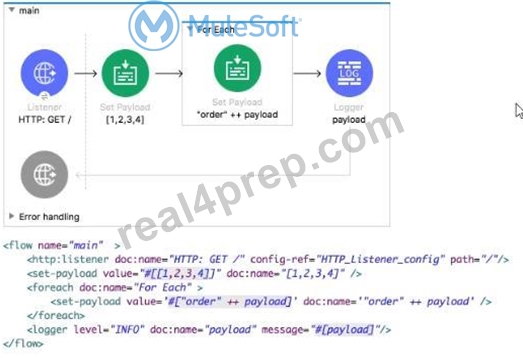
- A. [order1, order2, order3, order4]
- B. order4
- C. [1, 2, 3, 4]
- D. order1order2order3order4
Answer: C
NEW QUESTION 99
A RAML specification is defined to manage customers with a unique identifier for each customer record.
What URI does MuleSoft recommend to uniquely access the customer identified with the unique ID 1234?
- A. /customers?operation=get&custid=1234
- B. /customers/1234
- C. /customers?custid=true&custid=1234
- D. /customers/custid=1234
Answer: B
NEW QUESTION 100
Refer to the exhibit.
What is the correct syntax to add an employee ID as a URI parameter in an HTTP Listener path?
- A. # [employeelD]
- B. ${emp!oyeelD}
- C. {employeelD}
- D. (employeelD)
Answer: C
NEW QUESTION 101
Refer to the exhibits.
The Set Payload transformer In the addltem subflow uses DataWeave to create an order object.
What is the correct DataWeave code for the Set Payload transformer in the createOrder flow to use the addltem subflow to add a router cable with the price of 100 to the order?
- A. addltemf { price: "100", item: "router", itemType: "cable" })
- B. addltemf { payload: { price: "100", item: "router", itemType: "cable" } > )
- C. lookupf "addltem", { price: "100", item: "router", itemType: "cable" } )
- D. lookupf "addltem", { payload: { price: "100", item: "router", itemType: "cable" } } )
Answer: D
NEW QUESTION 102
Refer to the exhibits.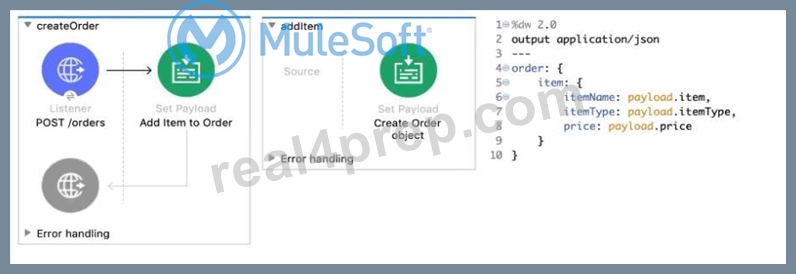
The Set Payload transformer In the addltem subflow uses DataWeave to create an order object.
What is the correct DataWeave code for the Set Payload transformer in the createOrder flow to use the addltem subflow to add a router cable with the price of 100 to the order?
- A. addltemf { price: "100", item: "router", itemType: "cable" })
- B. addltemf { payload: { price: "100", item: "router", itemType: "cable" } > )
- C. lookupf "addltem", { price: "100", item: "router", itemType: "cable" } )
- D. lookupf "addltem", { payload: { price: "100", item: "router", itemType: "cable" } } )
Answer: D
NEW QUESTION 103
In an application network. If the implementation but not the interface of a product API changes, what needs to be done to the other APIs that consume the product API?
- A. The applications associated with the other APIs must be recoded
- B. The other APIs must be updated to consume the updated product API
- C. The applications associated with the other APIs must be restarted
- D. Nothing needs to be changed in the other APIs or their associated applications
Answer: D
NEW QUESTION 104
Refer to the exhibits.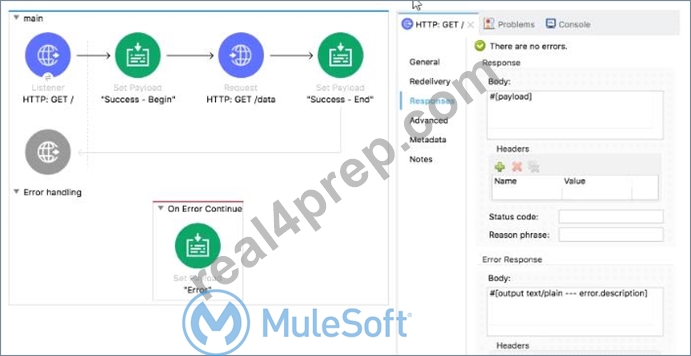

A web client submits a request to the HTTP Listener and the HTTP Request throws an error.
What payload and status code are returned to the web client?
Refer to the exhibits. A web client submits a request to the HTTP Listener and the HTTP Request throws an error.
What payload and status code are returned to the web client?
- A. Response body: "Error" Default response status code: 200
- B. Response body: "Success - Begin* Default response status code: 200
- C. Error response body: error, description Default error response status code: 500
- D. Response body: "Success - End" Default response status code: 200
Answer: A
Explanation:
Correct answer: Response body: "Error" Default response status code: 200.
-------------------------------------------------------------------------------------------------------------------------------------------------
1) Payload is successfully set to "Success - Started Flow"
2) When HTTP Request throws an error, execution halts
#[error.description] = "ABC"
#[error.errorType] = "XYZ"
3) The On Error Continue scope handles the error. When On Error Continue scope is invoked, all the processors in error block are executed and success response is sent back to the client with payload which is set in error flow. In this case payload is set to "Error" value in error block.
4) "Error" is returned to the requestor in the body of the HTTP request with HTTP Status Code: 200 as On error continue always sends success error code.
Reference Diagram: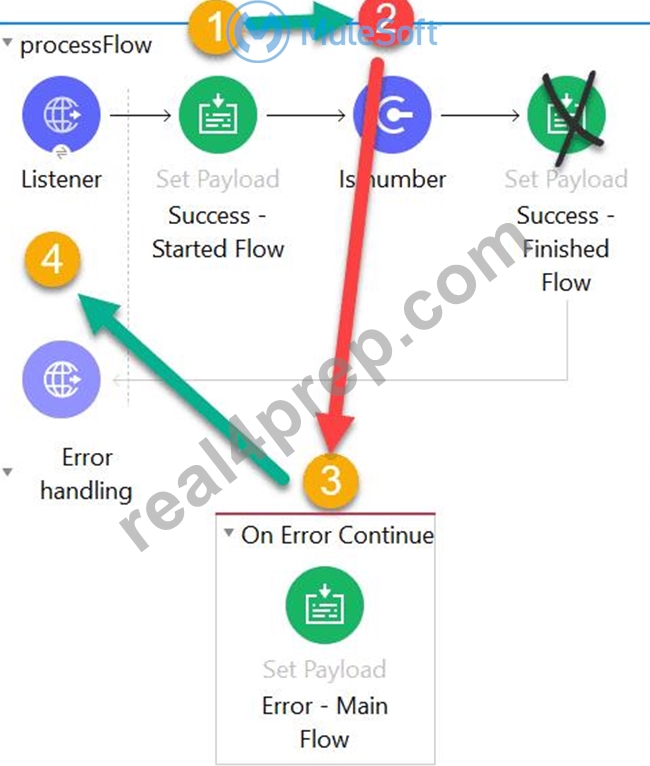
NEW QUESTION 105
Refer to the exhibits.
The orders.csv file is read, then processed to look up the orders in a database. The Mule application is debugged in Any point Studio and stops at the breakpoint.
What is the payload shown in the debugger at this breakpoint?
- A. 0
- B. The database response
- C. The entire CSV file
- D. "none"
Answer: A
NEW QUESTION 106
Refer to the exhibit.
What is the output payload in the On Complete phase
- A. The original payload: [1,2,31
- B. The records processed by the last batch step: [StepTwol, StepTwo2, StepTwo3]
- C. The records processed by all batch steps: [StepTwostepOnel, stepTwostepOne2, StepTwoStepOne3]
- D. summary statistics with NO record data
Answer: A
NEW QUESTION 107
Refer to the exhibit.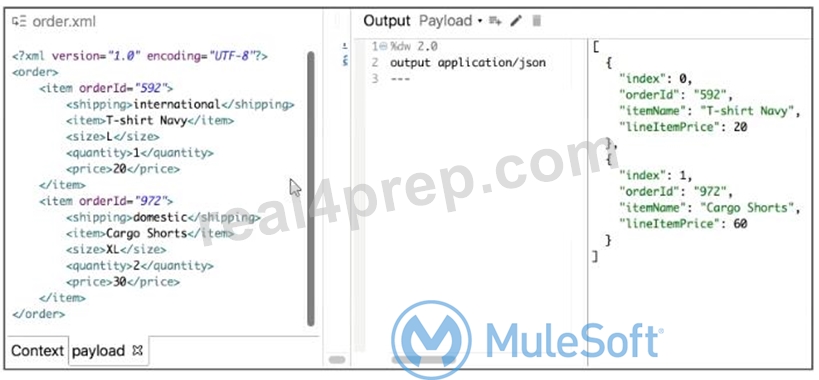
What Database expression transforms the input to the output?
A)
B)
C)
D)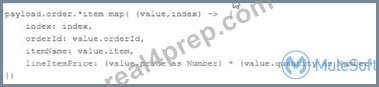
- A. Option B
- B. Option D
- C. Option C
- D. Option A
Answer: A
NEW QUESTION 108
Refer to the exhibit.
What Database expression transforms the input to the output?
A)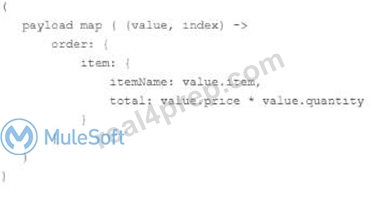
B)
C)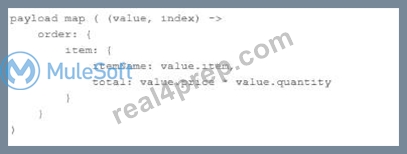
D)
- A. Option C
- B. Option B
- C. Option D
- D. Option A
Answer: A
NEW QUESTION 109
Refer to the exhibits.
The two Mule configuration files belong to the same Mule project. Each HTTP Listener is configured with the same host string and the port number, path, and operation values are shown in the display names.
What is the minimum number of global elements that must be defined to support all these HTTP Listeners?
- A. 0
- B. 1
- C. 2
- D. 3
Answer: D
Explanation:
In this case three configurations will be required each for port 8000, 6000 and 7000.
There would be three global elements defined for HTTP connections.
Each HTTP connection will have host and port. One example shown below with host as localhost and port 6000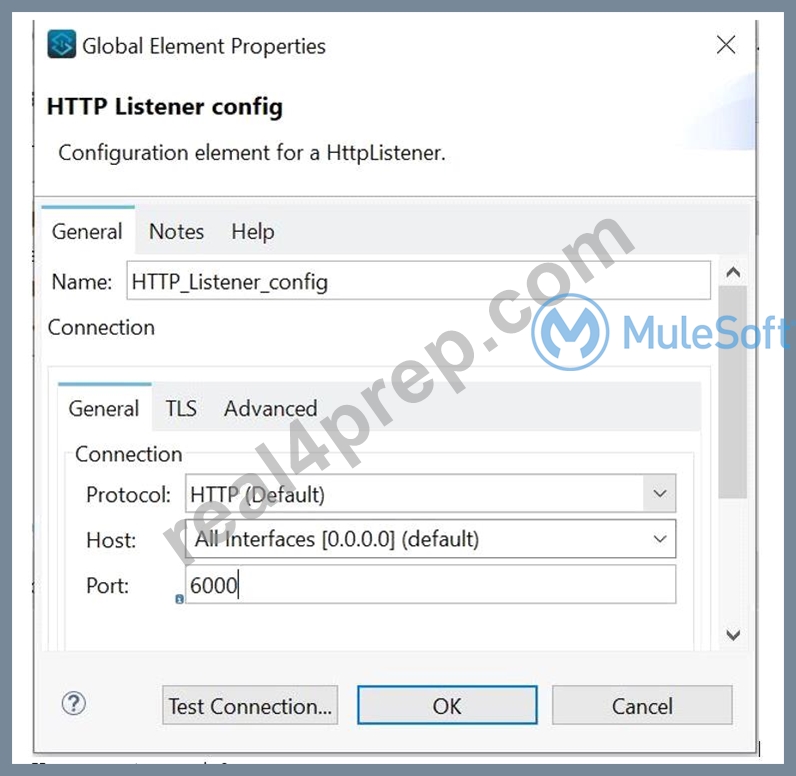
NEW QUESTION 110
Refer to the exhibit.
What data is expected by the POST /accounts endpoint?
A)
B)
C)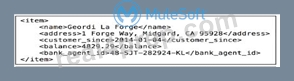
D)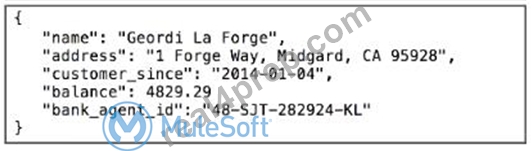
- A. Option B
- B. Option C
- C. Option A
- D. Option D
Answer: D
NEW QUESTION 111
Refer to the exhibits.

The Validation component in the private flow throws an error. What response message is returned to a client request to the main flow's HTTP Listener?
- A. Error - main flow
- B. Success - main flow
- C. Validation Error
- D. Error - private flow
Answer: B
NEW QUESTION 112
Which of the below functionality is provided by zip operator in DataWeave?
- A. All of the above
- B. Merges elements of two lists (arrays) into a single list
- C. Minimize the size of long text using encoding.
- D. Used for sending attachments
Answer: B
Explanation:
Correct answer is Merges elements of two lists (arrays) into a single list MuleSoft Doc Reference : https://docs.mulesoft.com/mule-runtime/4.3/dw-core-functions-zip
NEW QUESTION 113
Which of the module is imported automatically in Dataweave scripts?
- A. dw::core
- B. dw::System
- C. dw::Crypto
- D. dw::Runtime
Answer: A
Explanation:
Core (dw::Core) This module contains core DataWeave functions for data transformations. It is automatically imported into any DataWeave script.
NEW QUESTION 114
A Utlility.dwl is located in a Mule project at src/main/resources/modules. The Utility.dwl file defines a function named encryptString that encrypts a String What is the correct DataWeave to call the encryptString function in a Transform Message component?
- A. 1. %dw 2.0
2. output application/json
3. import modules::Utility
4. ---
5. Utility::encryptString( "John Smith" ) - B. 1. %dw 2.0
2. output application/json
3. import modules::Utility
4. ---
5. encryptString( "John Smith" ) - C. 1. %dw 2.0
2. output application/json
3. import modules.Utility
4. ---
5. Utility.encryptString( "John Smith" ) - D. 1. %dw 2.0
2. output application/json
3. import modules.Utility
4. ---
5. encryptString( "John Smith" )
Answer: B
Explanation:
Correct answer is
%dw 2.0
output application/json
import modules::Utility
---
Utility::encryptString( "John Smith" )
DataWeave 2.0 functions are packaged in modules. Before you begin, note that DataWeave 2.0 is for Mule 4 apps. For Mule 3 apps, refer to DataWeave Operators in the Mule 3.9 documentation. For other Mule versions, you can use the version selector for the Mule Runtime table of contents.
Functions in the Core (dw::Core) module are imported automatically into your DataWeave scripts. To use other modules, you need to import the module or functions you want to use by adding the import directive to the head of your DataWeave script, for example:
import dw::core::Strings
import camelize, capitalize from dw::core::Strings
import * from dw::core::Strings
The way you import a module impacts the way you need to call its functions from a DataWeave script. If the directive does not list specific functions to import or use * from to import all functions from a function module, you need to specify the module when you call the function from your script. For example, this import directive does not identify any functions to import from the String module, so it calls the pluralize function like this: Strings::pluralize("box").
Transform
%dw 2.0
import dw::core::Strings
output application/json
---
{ 'plural': Strings::pluralize("box") }
NEW QUESTION 115
Refer to the exhibit.
The API needs to be updated using the company-wide standard for the Plan data type. The Object data type has already been published in Anypoint Exchange with the global reference .
ACME/DataTypes/PlanDataType.raml.
What is a valid RAML specification that reuses the Plan data type?
A)
B)
C)
D)
- A. Option B
- B. Option C
- C. Option A
- D. Option D
Answer: D
NEW QUESTION 116
......
How much MuleSoft Certified Developer - Level 1 Exam Cost
The price of the MuleSoft Certified Developer - Level 1 exam is $250 USD.
MCD-Level-1 Exam Questions – Valid MCD-Level-1 Dumps Pdf: https://lead2pass.real4prep.com/MCD-Level-1-exam.html