


A short study window does not have to derail your S90.09 plans. Real4Prep organizes 40 focused practice questions for SOA Design & Architecture Lab, helping you spend revision time where it can make the greatest difference.
SOA S90.09 Exam Syllabus Topics:
| Section | Weight | Objectives |
|---|---|---|
| SOA Governance & Security | 15% | - Security considerations in architectural design - Scalability, reliability & performance design - Design-time governance & standards compliance |
| SOA Design Principles & Patterns | 30% | - Standard service-orientation design patterns - Granularity, versioning & dependency management - Loose coupling, autonomy, reusability, composability |
| Service-Oriented Analysis & Design | 25% | - Service contract & interface design - Requirements analysis & service identification - Service modeling & categorization |
| Deployment & Architecture Assessment | 10% | - Trade-off analysis & decision justification - SOA blueprint & enterprise architecture alignment |
| Service Composition & Orchestration | 20% | - Composition logic & workflow design - Orchestration vs choreography - Integration & messaging patterns |
SOA S90.09 Certification Exam FAQ
The S90.09 exam, SOA Design & Architecture Lab, assesses whether a candidate can apply SOA knowledge to the skills measured by this credential. It is associated with the Certified SOA Architect, SOA Certified Professional (SOACP) certification. The certification is positioned at the Expert / Advanced level. Related credentials include Certified SOA Consultant, Certified SOA Security Specialist, Certified Microservices Architect.
The S90.09 exam includes 40–70 questions and allows 90–100. Plan your pacing before exam day rather than calculating it under pressure. Timed sessions with Real4Prep practice tests can help you decide when to flag a difficult item, keep moving, and reserve enough time for a final review.
The published passing score for SOA Design & Architecture Lab is 70% or 700/1000, and the official exam fee is $295 USD. A retake requires budgeting for the full official fee again, so it is sensible to complete several timed practice tests before scheduling. Consistent results across the 40 practice questions can give you a clearer picture of your readiness.
The stated prerequisite information for SOA Design & Architecture Lab is: Recommended: S90.01, S90.02, S90.03, S90.04, S90.05, S90.08 or equivalent knowledge; strong practical experience in SOA design Before registering, review the eligibility details on the official exam page to confirm the requirements.
You can register for SOA Design & Architecture Lab through the following channels:
The available exam delivery format is Online proctored or onsite at Pearson VUE testing centers.
The following official training resources are recommended for SOA Design & Architecture Lab:
After reviewing these training options, you can reinforce each topic with 40 practice questions from Real4Prep.
Yes. Real4Prep provides a free PDF demo so you can review the format and quality of the SOA Design & Architecture Lab practice questions before placing an order. Your purchase includes 365 days of free updates, and you can extend the update service after expiration at a 50% discount.
If you take the corresponding S90.09 exam within 60 days of purchase and do not pass, you may apply for a full refund under the 100% Money Back Guarantee. Claims based on an exam taken within 3 days of purchase are not eligible; free materials, expired orders, and downloaded products that were not used before sitting for the exam are also excluded. The candidate name must match the payer name.
To apply, submit a scanned enrollment slip and the official Score Report PDF within 2 days after the exam. Eligible requests are processed within 7 days. If you prefer an alternative, you may receive two free products of equal value and keep the update service for your original purchase.
Delivery is instant after payment. Your download is also sent to your email within one minute; if it has not arrived within 2 hours, contact customer service. There is no limit on the number of computers on which the material can be installed.
The published SOA Design & Architecture Lab outline contains 5 major domains. The opening domains include:
- Service-Oriented Analysis & Design (25%)
- SOA Governance & Security (15%)
- SOA Design Principles & Patterns (30%)
Review the complete Exam Topics section above for every domain and subtopic before planning your study time.
SOA Design & Architecture Lab Sample Questions:
Service Consumer A sends a message with a business document to Service A (1), which
writes the business document to Database A (2). Service A then forwards the business
document to Service B (3), which writes the business document to Database B (4).
Service B then responds to Service A with a message containing a failure or success code
(5) after which Service A responds to Service Consumer A with a message containing a
failure or success code (6). Upon receiving the message, Service Consumer A updates a
log table in Database B (7). The log entry is comprised of the entire business document.
Database A is dedicated to the Service A service architecture and Database B is a shared
database.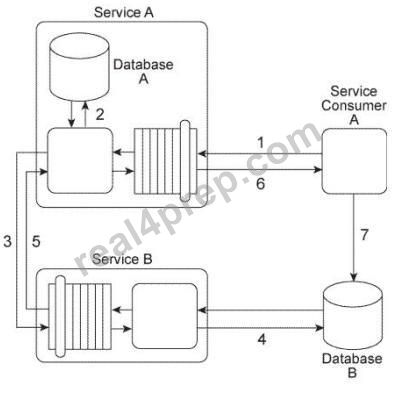
You are told that the database updates performed by Service A and Service B must be
either both successful or they cannot happen at all. The database update performed by
Service Consumer A must happen after it is given the outcome of the database updates
performed by Service A and Service B . Given that Service Consumer A must also update
Database B as part of this service composition architecture, how is it possible to fulfill these
requirements?
- A. None of the above.
- B. The State Repository pattern can be applied so that Service A writes the business
document data to a separate state database until it receives a response message from
Service B . If the response message contains a success code, Service A writes the
business document to Database A.
If the response contains a failure code, Service A
discards the data that was written to the state database. - C. The Service Data Replication pattern can be applied to Service Consumer A and
Service B so that separate dedicated databases can be established allowing Service
Consumer A to make updates independently of Service B . Service A is simply redesigned
to not write the business document to Database A until after it receives a message
containing a success code from Service B. - D. The Atomic Service Transaction pattern can be applied to encompass Service A,
Service B and Service Consumer A.
This will guarantee that all of the actions performed by the service composition participants will either be successful or will be rolled back if anyone
is not successful.
Correct Answer: A 🗳️
Service A is a task service that is required to carry out a series of updates to a set of
databases in order to complete a task. To perform the database updates Service A must
interact with three other services, each of which provides standardized data access
capabilities.
Service A sends its first update request message to Service B (1), which then responds
with a message containing a success or failure code (2). Service A then sends its second
update request message to Service C (3), which also responds with a message containing
a success or failure code (4). Finally, Service A sends a request message to Service D (5),
which responds with its own message containing a success or failure code (6).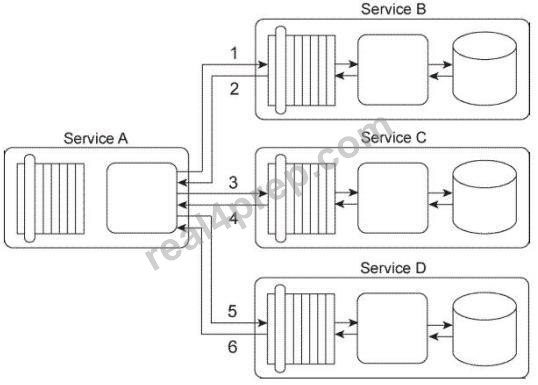
You've been asked to change this service composition architecture in order to fulfill a set of
new requirements: First, if the database update performed by Service B fails, then it must
be logged by Service A.
Secondly, if the database update performed by Service C fails,
then a notification e-mail must be sent out to a human administrator. Third, if the database
update performed by either Service C or Service D fails, then both of these updates must
be reversed so that the respective databases are restored back to their original states.
What steps can be taken to fulfill these requirements?
- A. None of the above.
- B. The Atomic Service Transaction pattern is applied so that Services A, C, and D are
encompassed in the scope of a transaction that will guarantee that if the database updates
performed by either Service C or Service D fails, then both updates will be rolled back. The
Compensating Service Transaction pattern is then applied to all services so that the scope
of the compensating transaction includes the scope of the atomic transaction. The
compensating exception logic that is added to Service D automatically invokes Service B to
log the failure condition and Service C to issue the e-mail notification to the human
administrator. This way, it is guaranteed that the compensating logic is always executed
together with the atomic transaction logic. - C. Service A is updated to perform a logging routine when Service A receives a response
message from Service B containing a failure code. Service A is further updated to send an
e-mail notification to a human administrator if Service A receives a response message from
Service C containing a failure code. The Atomic Service Transaction pattern is applied so
that Services A, C, and D are encompassed in the scope of a transaction that will
guarantee that if the database updates performed by either Service C or Service D fails,
then both updates will be rolled back. - D. The Compensating Service Transaction pattern is applied to Service B so that it invokes
exception handling logic that logs failed database updates before responding with a failure
code back to Service A . Similarly, the Compensating Service Transaction pattern is
applied to Service C so that it issues an e-mail notification to a human administrator when a
database update fails. The Atomic Service Transaction pattern is applied so that Services
A, C, and D are encompassed in the scope of a transaction that will guarantee that if the
database updates performed by either Service C or Service D fails, then both updates will
be rolled back. The Service Autonomy principle is further applied to Service A to ensure
that it remains consistently available to carry out this sequence of actions.
Correct Answer: C 🗳️
The architecture for Service A displayed in the Figure shows how the core logic of Service
A has expanded over time to connect to a database and a proprietary legacy system (1)
and to support two separate service contracts (2) that are accessed by different service
consumers.
The service contracts are fully decoupled from the service logic. The service logic is
therefore coupled to the service contracts and to the underlying implementation resources
(the database and the legacy system).
Service A currently has three service consumers. Service Consumer A and Service
Consumer B access Service A's two service contracts (3, 4). Service Consumer C
bypasses the service contracts and accesses the service logic directly (5).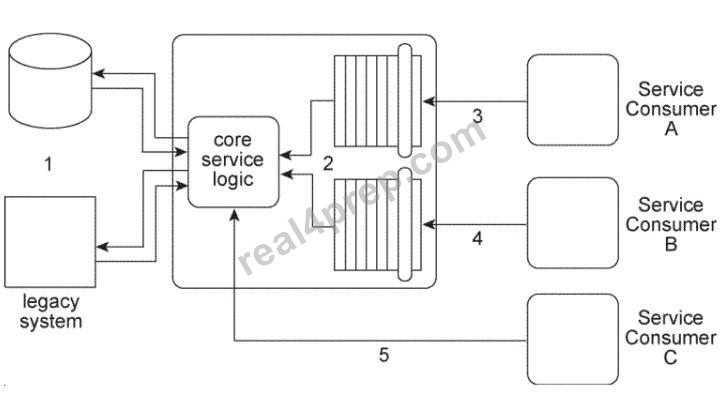
You are told that the database and legacy system that are currently being used by Service
A are being replaced with different products. The two service contracts are completely
decoupled from the core service logic, but there is still a concern that the introduction of the
new products will cause the core service logic to behave differently than before. What steps
can be taken to change the Service A architecture in preparation for the introduction of the
new products so that the impact on Service Consumers A, B, and C is minimized?
- A. None of the above.
- B. The Service Facade pattern can be applied to position Facade components between the
core service logic and the two service contracts. These Facade components will be
designed to regulate the behavior of Service A . The Contract Centralization pattern can
also be applied to force Service Consumer C to access Service A via one of its existing
service contracts. - C. The Service Abstraction principle can be applied to hide the implementation details from
the core service logic of Service A, thereby shielding this logic from changes to the
implementation. In support of this, the Service Facade pattern can be applied to position
Facade components between the core service logic and Service Consumers A and B.
These Facade components will be designed to regulate the behavior of Service A . The
Contract Centralization pattern can be applied to force Service Consumer C to access
Service A via one of its existing service contracts. - D. A third service contract can be added together with the application of the Contract
Centralization pattern. This will force Service Consumer C to access Service A via the new
service contract. The Service Facade pattern can be applied to position a Facade
component between the new service contract and Service Consumer C in order to regulate
the behavior of Service A . The Service Abstraction principle can be applied to hide the
implementation details of Service A so that no future service consumers are designed to
access any of Service A's underlying resources directly.
Correct Answer: B 🗳️
Service A sends a message to Service B (1). After Service B writes the message contents
to Database A (2) it issues a response message back to Service A (3). Service A then
sends a message to Service C (4). Upon receiving this message, Service C sends a
message to Service D (5), which then writes the message contents to Database B (6) and
issues a response message back to Service C (7).
Service A and Service D are in Service Inventory A.
Service B and Service C are in Service Inventory B.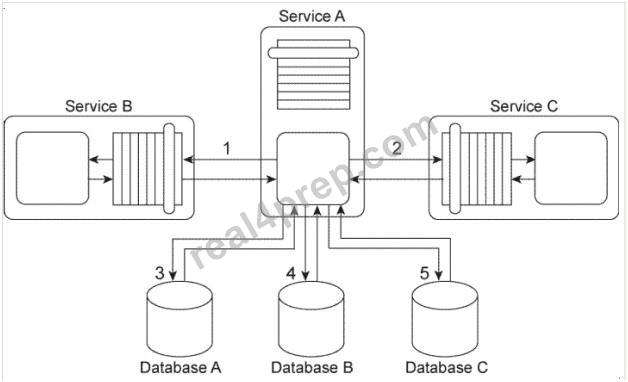
You are told that in this service composition architecture, all four services are exchanging
invoice-related data in an XML format. However, the services in Service Inventory A are
standardized to use a different XML schema for invoice data than the services in Service
Inventory B.
Also, Database A can only accept data in the Comma Separated Value (CSV)
format and therefore cannot accept XML formatted data. Database B only accepts XML
formatted data. However, it is a legacy database that uses a proprietary XML schema to
represent invoice data that is different from the XML schema used by services in Service
Inventory A or Service Inventory B.
What steps can be taken to enable the planned data exchange between these four services?
- A. None of the above.
- B. The Data Model Transformation pattern can be applied so that data model
transformation logic is positioned between Service A and Service B, between Service A
and Service C, between Service C and Service D, and between the Service D logic and
Database B.
The Data Format Transformation pattern can be applied so that data format
transformation logic is positioned between the Service B logic and Database A. - C. The Data Model Transformation pattern can be applied so that data model
transformation logic is positioned between Service A and Service B, between Service C
and Service D, and between the Service D logic and Database B.
The Data Format Transformation pattern can be applied so that data format transformation logic is positioned
between Service A and Service C, and between the Service B logic and Database A. - D. The Data Model Transformation pattern can be applied so that data model
transformation logic is positioned between the Service B logic and Database A.
The Data Format Transformation pattern can be applied so that data format transformation logic is
positioned between Service A and Service B, between Service A and Service C, between
Service C and Service D, and between the Service D logic and Database B.
Correct Answer: B 🗳️
Viewing page 1 out of 10 pages.
Viewing questions 1-4 out of 40 questions.


