


Your study plan should not wait on shipping. Once you order, Real4Prep emails the C90.06 files within a minute, and all 15 practice questions for the SOA Cloud Architecture Lab are ready to use the same evening.
SOA C90.06 Exam Syllabus Topics:
| Section | Weight | Objectives |
|---|---|---|
| Topic 1: Cloud Computing Fundamentals Application | 15% | - Application of Fundamental Cloud Concepts
|
| Topic 2: Cloud Technology Implementation | 20% | - Cloud Technology Usage
|
| Topic 3: Fundamental Cloud Architecture | 20% | - Architectural Design Practices
|
| Topic 4: Advanced Cloud Architecture | 25% | - Advanced Architectural Patterns
|
| Topic 5: Cloud Architecture Lab Scenarios | 20% | - Hands-On Architecture Analysis
|
Your SOA Cloud Architecture Lab Questions, Answered
Yes. Real4Prep provides a free PDF demo of the C90.06 practice questions, so you can check the format and quality before paying anything. Every purchase also includes 365 days of free updates, and once that period expires you can extend the update service at a 50% discount from your member zone.
The C90.06 exam gives you 90-120 to work through 15 questions, so the clock moves faster than most candidates expect. Keep a steady pace on every item, flag the ones that stall you, and circle back with the time you have banked instead of getting stuck. Time pressure is mostly a rehearsal problem: run at least one full timed mock in the Real4Prep test engine before your appointment, and the real countdown will feel familiar rather than threatening.
The C90.06 exam — officially titled Cloud Architecture Lab — is the SOA test you pass to earn the SOA Certification certification. It sits at the Professional level of the SOA certification program. Related certifications include Certified Cloud Architect, Advanced Cloud Architecture (C90.05), Fundamental Cloud Computing (C90.01), Cloud Technology Concepts (C90.02), Cloud Technology Lab (C90.03). If that is the credential you are after, the 15 practice questions at Real4Prep map directly to its official objectives.
The SOA Cloud Architecture Lab blueprint is organized into 5 domains. The first three are:
- Cloud Technology Implementation (20%)
- Cloud Architecture Lab Scenarios (20%)
- Advanced Cloud Architecture (25%)
The complete, current topic list appears in the exam outline section above — review it before you start drilling the Real4Prep practice questions.
Recommended: Completion of C90.01, C90.02, C90.03 and C90.05 or equivalent knowledge and experience.
Eligibility rules do change, so confirm the current requirements on the official exam page before you apply: https://www.arcitura.com/cloudarchitect.
If you take the corresponding C90.06 exam within 60 days of purchase and do not pass, you can apply for a full refund under our money-back guarantee. Send a scanned copy of your exam enrollment slip together with the official Score Report PDF within 2 days of your exam date, and your claim will be processed within 7 days. Keep in mind that the candidate name must match the purchaser name, and the guarantee does not cover attempts made within 3 days of purchase, materials that were downloaded but never used in an actual exam sitting, free resources, or expired orders. If you would rather keep studying, you can swap the refund for two free exam products of equal value while keeping the update service on your original purchase. Delivery itself is instant: the files are emailed to you within one minute of payment (if nothing arrives within 2 hours, check your spam folder and contact our support team), and there is no limit on how many computers you install them on.
The passing score for the C90.06 exam is 70%, and the official registration fee is USD $250. Remember that an unsuccessful attempt means paying the full USD $250 again to retake it, so booking too early is the expensive way to find out you are not ready. Test yourself with the Real4Prep practice questions first; once you can clear 70% comfortably on timed runs, scheduling the real exam becomes a much safer bet.
SOA Cloud Architecture Lab Sample Questions:
Ready-Made Environment A is hosted by Virtual Server A and Ready-Made Environments is hosted by Virtual Server B.
Virtual Servers A and B are hosted by Hypervisor A, which is part of a hypervisor cluster. An automated scaling listener intercepts cloud consumer requests and automatically invokes the on-demand generation of additional instances of ready-made environments, as required.
A self-service portal and a usage and administration portal are also available to cloud consumers. The self-service portal can be used to request the provisioning of a new ready- made environment. Any cloud consumer that has already had a ready-made environment provisioned can configure and view information about that ready-made environment via the usage and administration portal.
Cloud Consumer A accesses Ready-Made Environment A to work on the development of a new cloud service (1). Cloud Consumer B accesses Ready-Made Environment B to test a recently completed application comprised of three cloud services (2). Cloud Consumer C accesses the self-service portal to request the creation of a new ready-made environment (3).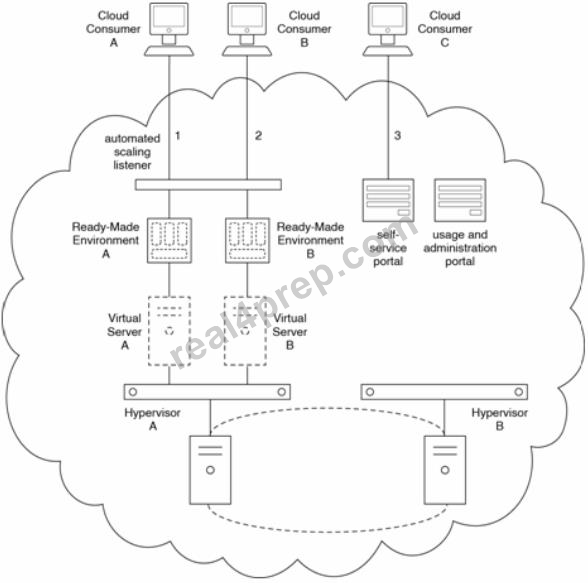
The cloud provider is required to perform an emergency maintenance outage on a cloud storage device used by all ready-made environments. The unplanned outage takes two hours. During this period, Cloud Consumers A and B are unable to access Ready-Made Environments A and B and Cloud Consumer C receives an error when submitting a request to create a new ready-made environment.
After the maintenance outage is over, Cloud Consumers A and B encounter the following problems:
* Cloud Consumer A is unable to recover session data that was kept in memory for an extended period, prior to the time of the outage.
* Cloud Consumer B has no access to Virtual Server B, which was moved to Hypervisor B during the maintenance outage. When Cloud Consumer B attempts to ping Virtual Server B, the request times out.
Even though Cloud Consumer C is able to log into the usage and administration portal to confirm that its ready-made environment was successfully provisioned, the unexpected outage has raised concerns about the stability of the ready-made environment's underlying infrastructure. Cloud Consumer C informs the cloud provider that it cannot proceed with its lease of the ready-made environment if there are future occurrences of this type of maintenance outage.
Which of the following statements can help address the problems and concerns of the three cloud consumers?
- A. None of the above.
- B. The Elastic Disk Provisioning and Cross-Storage Device Vertical Tiering patterns can be applied to establish a cloud architecture that supports a set of cloud storage devices, each with different tiers that cloud consumers can choose to scale to The Synchronized Operating State pattern can be applied in combination with the Hypervisor Clustering pattern to avoid further virtual server and ready-made environment connectivity problems.
The Redundant Storage pattern can be applied so that if a cloud storage device fails, a secondary implementation of the cloud storage device automatically takes over processing tasks, thereby avoiding outages. - C. The Service State Management pattern can be applied to establish a system that can persist session data in a database. The Persistent Virtual Network Configuration pattern can be applied to centralize the configuration data necessary for virtual servers to remain accessible after they have been relocated to different hypervisors. The Storage Maintenance Window pattern can be applied to establish a system that allows cloud storage devices to be maintained without causing outages.
- D. A combination of the Load Balanced Virtual Server Instances and Synchronized Operating State patterns can be applied to establish a system capable of deferring state across multiple cloud storage devices, each located on a different virtual server. The Elastic Disk Provisioning pattern can be applied to persist virtual server configuration data across hypervisors so that connectivity is preserved whenever a virtual server is relocated to a different hypervisor. The Zero Downtime pattern can be applied to ensure that none of the ready-made environments or virtual servers are subject to a maintenance outage in the future.
Correct Answer: C 🗳️
Cloud Storage Device A contains LUN A and can be accessed by external cloud consumers via a proprietary user portal that is used primarily by cloud consumers to upload and manage data for backup purposes. Pay-Per-Use Monitor A tracks the amount of data being uploaded and forwards this information to a billing management system. Cloud Storage Device B is a secondary cloud storage device. Data from Cloud Storage Device A is replicated synchronously to Cloud Storage Device B using a storage replication program (not shown). Cloud Storage Device A is further administered by a cloud resource administrator that works for the cloud provider, who accesses the cloud storage device via an internal usage and administration portal.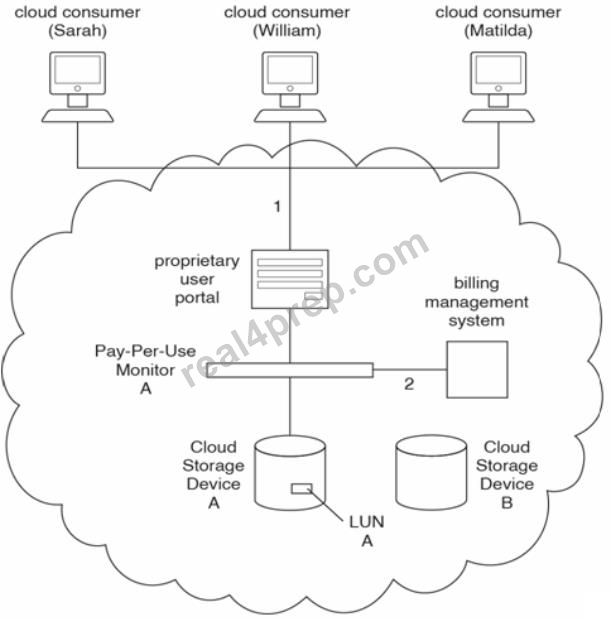
Three different cloud consumers (Sarah. William, Matilda) access Cloud Storage Device A to upload data for backup purposes (1). These three cloud consumers belong to different departments within the same organization, and therefore all three share LUN A.
Pay-Per- Use Monitor A collects the storage space data and forwards it to the billing management system (2).
The cloud provider offers premium and discount storage plans. With the premium plan, the data stored on Cloud Storage Device A is also replicated to Cloud Storage Device B.
With the discount plan, the data stored on Cloud Storage Device A is not replicated. Both plans are based on fixed-disk storage allocation. The cost of the premium plan is $5 per week for every GB of storage space and the cost of the discount plan is $2 per week for every GB of storage space. The SLA from the cloud provider guarantees availability of 97% for access to Cloud Storage Device A.
The three cloud consumers use Cloud Storage Device A as follows:
* Sara signs up for the discount backup plan and is allocated 50 GBs of storage space. A week later, she uploads 10 GBs of backup data. A week after that, she uploads another 35 GBs. She later finds out that for those two weeks her organization was billed $200, which is more than she was expecting. After she complains to the cloud provider, she learns about how fixed-disk storage allocation is billed. She asks the cloud provider to change her account to a different storage plan where she is only billed for the actual amount of storage space she uses at any given time. The cloud provider assures her that a new system will be set up to accommodate this request.
* William is on the premium backup plan. He uploads 1 to 3 GBs of important business data every day. After two weeks of daily uploads, he realizes that the centralized nature of the backup data on the cloud makes it more convenient for reporting purposes than the distributed nature of the same data in his on-premise environment. He uses an analysis tool to run queries against the cloud-based data. However, due to the large quantity of redundant data, the queries end up being ineffective and take too long to run. He asks the cloud provider to find a solution that can streamline the cloud-based data by reducing redundancy. By reducing the overall quantity of the data, the analysis queries will run faster.
* Matilda is on the discount backup plan and uploads backup data on a daily basis.
Over the course of two weeks she uploads over 200 GBs of data. She performs a daily backup at the end of each day by identifying the data to back up and then using the proprietary user portal to run the cloud backup procedure. This procedure can take 5 to 45 minutes, depending on the amount of data she is uploading. Matilda performs this as her last task of the day and therefore initiates the procedure before she leaves, but does not wait for it to complete. One day, she receives an e-mail from the cloud provider explaining that the backup procedure from the previous day had failed due to an unexpected hardware failure that occurred on Cloud Storage Device A.
The notification e-mail goes on to state that this type of failure falls within the 97% availability guarantee of her organization's SLA, and is therefore in compliance with the current provisioning agreement. Had a disaster occurred that night, the on-premise data could have been lost and Matilda would be held accountable. Matilda contacts the cloud provider to demand that the provisioning agreement be amended to upgrade their existing SLA to the maximum possible availability (which, for this cloud provider, is 99.999%). The cloud provider agrees to establish a system to accommodate this request.
Which of the following statements lists the patterns that can be applied to address the three issues raised by the three cloud consumers?
- A. Storage Workload Management, Elastic Disk Provisioning, Centralized Remote Administration
- B. None of the above.
- C. Elastic Disk Provisioning, Dynamic Data Normalization, Zero Downtime
- D. Storage Maintenance Window, Dynamic Failure Detection and Recovery, Broad Access
Correct Answer: C 🗳️
Viewing page 1 out of 8 pages.
Viewing questions 1-2 out of 15 questions.


