


The PL-100 exam does not reward hesitation, and it charges full price for every retake. The Microsoft Power Platform App Maker practice questions from Real4Prep are the useful review material that makes diligent effort actually pay off.
Microsoft PL-100 Exam Syllabus Topics:
| Section | Weight | Objectives |
|---|---|---|
| Topic 1: Create business solutions | 60–65% | - Implement Microsoft Dataverse
|
| Topic 2: Analyze and visualize data | 10–15% | - Connect to and prepare data
|
| Topic 3: Design business solutions | 20–25% | - Design data models and security
|
Microsoft PL-100 Exam: FAQ for Future Passers
Microsoft Power Platform App Maker is an official Microsoft certification exam, listed under the code PL-100. Passing it earns the Microsoft Certified: Power Platform App Maker Associate certification at the Associate level. It also ties into Microsoft Certified: Power Platform Fundamentals, Microsoft Certified: Power Platform Developer Associate. In an era of lifelong learning, this credential is one of the most efficient ways to prove your skills keep pace.
Microsoft Power Platform App Maker gives you 40–60 questions across 120 minutes. The efficient approach: one to two hours of daily timed practice in the Real4Prep engine builds both the knowledge and the pacing, so exam day feels like simply another well-run session.
Passing Microsoft Power Platform App Maker takes 700 (scale 100–1000), and the official registration fee is 165 USD. Retakes cost the full 165 USD again, so treat your Real4Prep practice scores as the decision-maker: book when the passing line sits below your everyday results, not your best ones.
The Microsoft Power Platform App Maker syllabus is organized into 3 domains, led by Create business solutions (60–65%), Analyze and visualize data (10–15%), and Design business solutions (20–25%). The complete breakdown is above on this page; it is the fastest way to learn where your limited preparation hours belong.
No formal prerequisites; recommended familiarity with Power Platform tools and low-code development
Vendor policies are revised periodically, so verify the current requirements before registering via the official exam page.
Registration for Microsoft Power Platform App Maker goes through the official channels below.
For planning: the exam is delivered Online proctored or onsite testing center.
Microsoft recommends the following training for Microsoft Power Platform App Maker candidates.
Follow any training with daily practice on the 279 questions in the Real4Prep PL-100 package; sorted by authorized expert groups, they turn course theory into exam-ready skill.
Yes on both counts. Download the free demo of the Microsoft Power Platform App Maker questions first, and browse the comments written by former customers for a second opinion. After purchase, new versions are sent to you as soon as they release, free for 365 days; after expiry, extending the update service costs 50% of the regular price.
Worry-free means a 100% money-back guarantee with stated conditions. Take the Microsoft Power Platform App Maker exam within 60 days of purchase; if you fail, you may claim a full refund, provided the exam matches your product. Attempts within 3 days of purchase are ineligible, as are downloaded-but-unused products, free materials, and expired orders; the candidate name must match the payer name. Submit a scanned enrollment slip and the official Score Report PDF within 2 days of the exam, and claims are processed within 7 days. Alternatively, exchange for two other exam products of equal value, free, keeping the update service on your original purchase.
Delivery is instant: download your files the moment you pay, with an email copy arriving within one minute. If nothing arrives within 2 hours, check spam and contact customer service, online 24/7 with infinite patience. Installation is unlimited across your computers.
Microsoft Power Platform App Maker Sample Questions:
You have a canvas app that uses multiple inputs for calculations.
You must use Test Studio to create automated tests and confirm that the app works as expected.
You need to organize your test scenarios into a hierarchy.
In which order should you create the objects? To answer, move the appropriate actions from the list of actions to the answer area and arrange them in the correct order.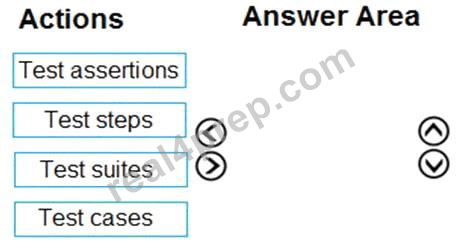
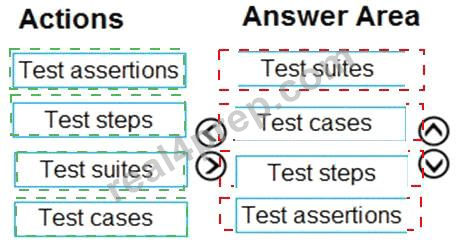
Correct Answer:
Explanation:
Text Description automatically generated with medium confidence
Step 1: Test suites
By default, a test suite and test case are created for you in Test Studio. Test suites are used to organize your test cases. An app can contain one or more test suites.
Step 2: Test cases
Depending on how you want to organize or group your tests, you can create multiple test cases in a test suite.
Each case can test a specific feature or a subset of functionalities in your app.
Step 3: Test steps
Step 4: Test assertions
A test case consists of test steps that contain actions. Test actions are written using Power Apps expressions that perform a task. You can use the recorder to automatically generate the test steps as you interact with your app. After you record, you can update the test case, add new steps, delete steps, and write test assertions to validate the result of your test.
Reference:
https://docs.microsoft.com/en-us/powerapps/maker/canvas-apps/working-with-test-studio
You need to ensure that the salespeople can save measurements. What should you do?
- A. Publish the app with a new version number.
- B. Update the security role assigned to the app to include missing permissions on the quote table.
- C. Update the security role assigned to the app to include missing permissions on the custom table.
Correct Answer: C 🗳️
In a Common Data Service database, you create a canvas app and a custom entity. The app also reads data from the Account entity in the Common Data Service database.
Entity access permissions will be controlled by the Common Data Service User security role. You create a Common Data Service solution.
You need to replicate the changes to a new Common Data Service database.
Which two components should you include with the canvas app? Each correct answer presents part of the solution.
NOTE: Each correct selection is worth one point.
- A. Account entity
- B. Sitemap
- C. Common Data Service User security role
- D. Custom entity
Correct Answer: A,C 🗳️
You need to meet the requirements for sales representative that submit status reports.
How should you configure the flow?
- A. Add a condition that evaluates the risk value by using a dynamic content variable
- B. Add a number functions action that evaluates the risk value by using a static variable to determine if an email is required
- C. Add a data operation action that evaluates a dynamic content variable
- D. Add a parallel branch that uses the value of a dynamic content variable
Correct Answer: A 🗳️
Explanation: Only visible for Real4Prep members. You can sign-up / login (it's free).
You create and publish a canvas app component library to perform complex calculations.
You discover an error in one of the calculations. You correct the issue and publish the component library. A co worker uses the original version of the component library in a canvas app.
You need to ensure that the co-worker uses the updated version of the component library.
What should you do?
- A. Instruct the co-worker to edit the canvas app and update the component library
- B. Export the updated component library and instruct the co-worker to import the updated version into the canvas app
- C. Inform the co-worker to edit the canvas app and manually add the updated version of the component library
Correct Answer: A 🗳️
Explanation: Only visible for Real4Prep members. You can sign-up / login (it's free).


