


Too many options can paralyze a decision — candidates call it choice phobia. Real4Prep makes the CIMA Financial Reporting call easy: a free demo of the F1 bank, expert-verified answers, and 365 days of free updates, all spelled out before you pay.
CIMA F1 Exam Syllabus Topics:
| Section | Weight | Objectives |
|---|---|---|
| The Regulatory Environment of Financial Reporting | 10% | - Conceptual framework and regulatory bodies - Ethics in financial reporting - IFRS Foundation and IASB structure - Principles vs rules-based regulation |
| Principles of Taxation | 20% | - Deferred tax concepts - Indirect taxes overview - Tax system and types of taxes - Current tax calculation |
| Financial Statements | 45% | - Interpretation and analysis of financial statements - Application of IFRS standards
- Preparation of single entity financial statements
|
| Managing Cash and Working Capital | 25% | - Cash management and forecasting - Short-term financing options - Management of receivables, inventory and payables - Working capital cycle and objectives |
Planning Your CIMA Financial Reporting? Start With These Answers
The current exam information lists 60 questions for the F1 exam, with 90 minutes minutes allowed. Practicing against the clock at home builds the pacing habits that exam day rewards.
The CIMA Financial Reporting blueprint covers these main domains:
- The Regulatory Environment of Financial Reporting (10%)
- Financial Statements (45%)
- Managing Cash and Working Capital (25%)
Additional domains complete the official outline, and our bank covers the full range.
You can register through these official channels:
Book early for the best choice of dates and locations — and double-check your spam folder for the confirmation email.
Your money is protected by clear conditions. If you fail the corresponding exam within 60 days of purchase, send us a scanned copy of your enrollment slip and your official Score Report PDF within two days of the exam date; verified claims receive a full refund within seven days. The exclusions: exams taken within three days of purchase, a candidate name that does not match the payer, and free or expired products. If you prefer, we can exchange your product for two others of equal value instead.
CIMA lists the following prerequisites for the CIMA Financial Reporting: CIMA Certificate in Business Accounting (Cert BA) or relevant degree / professional qualification for exemption; basic English and mathematics proficiency.
Check the official certification page for the latest requirements before booking.
Because we remove the guesswork at every step. The F1 bank consolidates the CIMA Financial Reporting knowledge points into expert-verified Q&As instead of leaving you to sift through the internet alone. A free demo shows the quality before you buy; instant delivery starts you the minute you do; 365 days of free updates — with a notification each time a new version releases — keep you current; and a strict information safety system plus a 7/24 golden-standard support team protect you throughout.
CIMA recommends the following official training options:
Structured coursework plus regular question practice is the combination most candidates find effective.
As of the latest information, the F1 exam requires a score of 100 out of 150 scaled score (~67%) to pass, and registration costs £110 / $135–$150 USD (varies by region). CIMA sets both figures, so verify them on the official site when you book.
Upon successful payment, our system automatically emails the product to your mailbox and shows an instant download link — delivery typically takes about a minute. If nothing arrives within two hours, check your spam folder first, then contact our 7/24 support team. Installations are unlimited. Your purchase also includes 365 days of free updates: whenever we release a new version, we notify you to download it — no need to wait or worry about validity — and a 50% renewal discount applies when the period ends.
CIMA Financial Reporting Sample Questions:
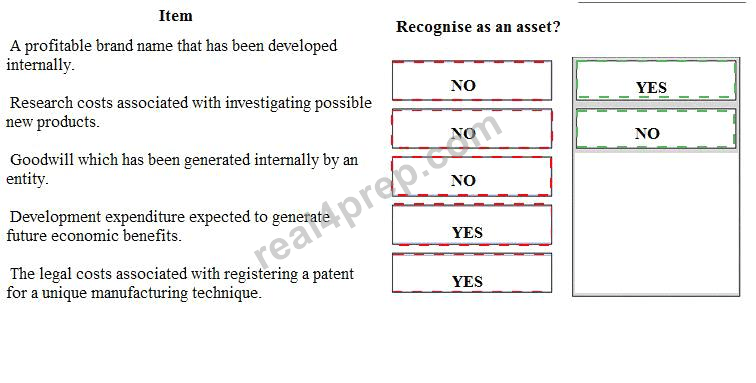
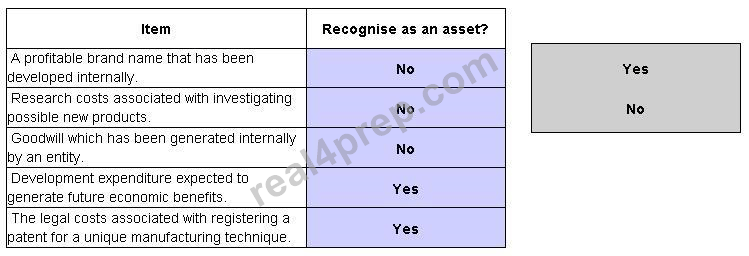
Identify from the list below which items can be recognised as assets within the financial statements of an entity in accordance with IAS 38 Intangible Assets. Place either yes or no as appropriate against each item.
Correct Answer:
The accounting profit before tax of an entity was $243,200 for the year ended 31 July 20X4.
The accounting profit included disallowable income from government grants of $48,000 and disallowable expenditure of $25,600 on entertaining expenses.
The entity also paid a $40,000 dividend to shareholders. The tax rates for the country were as follows:
Calculate the tax the entity is due to pay for the year ending 31 July 20X4.
- A. $57,546
- B. $44,160
- C. $47,840
- D. $39,174
Correct Answer: C 🗳️
An entity's policy is to finance the investment in working capital using short-term financing to fund all of its investment in fluctuating net current assets as well as some of its investment in permanent net current assets.
What is this working capital financing policy known as?
- A. Aggressive
- B. Moderate
- C. Conservative
- D. Short term
Correct Answer: A 🗳️
Which of the following is the main purpose of corporate governance regulation?
- A. To protect the interests of shareholders in a quoted entity.
- B. To guarantee that corporate scandals do not happen in the future.
- C. To ensure that financial reports are produced on a regular basis and in line with relevant regulations.
- D. To ensure that shareholder wealth is maximized.
Correct Answer: A 🗳️
UV has recently been having cash flow issues due to its credit customers paying after the credit period they have been granted.
UV is looking into factoring the receivables to a factoring company on a recourse basis to improve its cash flow.
Which TWO of the following will UV encounter as a result of employing the factoring company?
- A. No irrecoverable debts
- B. Reduction in payables days
- C. Increase in cash sales
- D. Reduction in bank overdraft charges
- E. Reduction in the need for management control
Correct Answer: D,E 🗳️
Viewing page 1 out of 50 pages.
Viewing questions 1-5 out of 247 questions.


